9 June 1870, Death of Fagin creator Charles Dickens #otdimjh

9 June 1870 Death of Charles Dickens, Creator of “Fagin the Jew” character #otdimjh

images (87)

Charles Dickens (7 February 1812 – 9 June 1870) was considered an anti-Semite by some because of his character Fagin in Oliver Twist.  Dickens defended himself against what he considered a false claim. In a later work, Our Mutual Friend, Dickens created the sympathetic Jewish character Mr. Riah who is the victim of a Christian moneylender. “The Jewish people are a people for whom I have a real regard and to whom I would not willingly have given an offense…for any worldly consideration.” [Wikipedia article]

images (85)

Dickens’ portrait of Fagin in one of his most widely read early novels Oliver Twist, has been seen by some as deeply antisemitic, though others such as Dickens’ biograper G.K. Chesterton [also considered by some to use anti-semitic motifs] have argued against this notion. The novel refers to Fagin 257 times in the first 38 chapters as “the Jew”, while the ethnicity or religion of the other characters is rarely mentioned.

330px-Fagin_from_Oliver_Twist

The role of Fagin in Oliver Twist continues to be a challenge for actors who struggle with questions as to how to interpret the role in a post-Nazi era. Various Jewish writers, directors, and actors have searched for ways to “salvage” Fagin.

220px-Solomon_portrait

Late in life, Dickens developed close friendships with Jews and unambiguously retracted his earlier antisemitic views and created a sympathetic Jewish character “Riah” (meaning “friend” in Hebrew) in his novel Our Mutual Friend, whose goodness, is almost as complete as Fagin’s evil. Riah says in the novel: “Men say, ‘This is a bad Greek, but there are good Greeks. This is a bad Turk, but there are good Turks.’ Not so with the Jews … they take the worst of us as samples of the best …”.

Fagin_the_Jew_cover

Prayer: Thank you Lord for the novels of Charles Dickens. All truth is a reflection of your truth, and all beauty a reflection of your beauty. Help us to see in Dickens works a reflection of your creative power, majesty and mystery. Help us also to discern where caricature becomes hate speech, and where it needs to be cleansed and repented of. In Yeshua’s name we pray. Amen.

http://en.wikipedia.org/wiki/Racism_in_the_work_of_Charles_Dickens#Fagin

Paul Vallely writes in The Independent that Dickens’s Fagin in Oliver Twist —the Jew who runs a school in London for child pickpockets—is widely seen as one of the most grotesque Jews in English literature.[21] The character is thought to have been partly based on Ikey Solomon, a 19th-century Jewish criminal in London, who was interviewed by Dickens during the latter’s time as a journalist.[22] Nadia Valdman, who writes about the portrayal of Jews in literature, argues that Fagin’s representation was drawn from the image of the Jew as inherently evil, that the imagery associated him with the Devil, and with beasts.[23]

The novel refers to Fagin frequently as simply “the Jew”, while the ethnicity or religion of the other characters is rarely mentioned.[21] In 1854, the Jewish Chronicle asked why “Jews alone should be excluded from the ‘sympathizing heart’ of this great author and powerful friend of the oppressed.” Eliza Davis, whose husband had purchased Dickens’s home in 1860 when he had put it up for sale, wrote to Dickens in protest at his portrayal of Fagin, arguing that he had “encouraged a vile prejudice against the despised Hebrew”, and that he had done a great wrong to the Jewish people.[24] Dickens had described her husband at the time of the sale as a “Jewish moneylender”, though also someone he came to know as an honest gentleman.

Dickens took her complaint seriously. He halted the printing of Oliver Twist, and changed the text for the parts of the book that had not been set, which is why Fagin is called “the Jew” 257 times in the first 38 chapters, but barely at all in the next 179 references to him. In his novel, Our Mutual Friend, he created the character of Riah (meaning “friend” in Hebrew), whose goodness, Vallely writes, is almost as complete as Fagin’s evil. Riah says in the novel: “Men say, ‘This is a bad Greek, but there are good Greeks. This is a bad Turk, but there are good Turks.’ Not so with the Jews … they take the worst of us as samples of the best …” Davis sent Dickens a copy of the Hebrew bible in gratitude.[21] Dickens not only toned down Fagin’s Jewishness in revised editions of Oliver Twist, but removed Jewish elements from his depiction of Fagin in his public readings from the novel, omitting nasal voice mannerisms and body language he had included in earlier readings.[25]

Joel Berkowitz reports that the earliest stage adaptations of Oliver Twist “followed by an almost unrelieved procession of Jewish stage distortions, and even helped to popularize a lisp for stage Jews that lasted until 1914”[26] It is widely believed that the most antisemitic adaptation of Oliver Twist is the David Lean film with Alec Guinness as Fagin. Guinness was made-up to look like the illustrations from the novel’s first edition. The film’s release in the US was much delayed due to Jewish protests, and was initially released with several of Fagin’s scenes cut. This particular adaptation of the novel was banned in Israel.[27] Ironically, the film was also banned in Egypt for portraying Fagin too sympathetically.[28] When George Lucas’ film Star Wars I: The Phantom Menace was released, he denied the claim made by some critics that the unscrupulous trader Watto (who has a hooked nose) was a Faginesque Jewish stereotype. However, animator Rob Coleman admitted that he viewed footage of Alec Guinness as Fagin in Oliver Twist to inspire his animators in creating Watto.[29]

In recent years, Jewish performers and writers have attempted to ‘reclaim’ Fagin as has been done with Shakespeare’s Shylock in Merchant of Venice. The composer of the 1960s musical Oliver, Lionel Bart, was Jewish, and he wrote songs for the character with a Jewish rhythm and Jewish orchestration.[27] In spite of the musical’s Jewish provenance, Jewish playwright Julia Pascal believes that performing the show today is still inappropriate, an example of a minority acting out on a stereotype to please a host society. Pascal says “U.S. Jews are not exposed to the constant low-level anti-Semitism that filters through British society”. In contrast to Pascal, Yiddish expert David Schneider found the Dickens novel, wherein Fagin is simply “the Jew,” a difficult read, but saw Fagin in the musical as “a complex character” who was not “the baddie.”[27] Jewish stage producer Menachem Golan also created a less well-known Hebrew musical of Oliver Twist.[30]

Some recent actors who have portrayed Fagin have tried to downplay Fagin’s Jewishness, but actor Timothy Spall both emphasised it while making Fagin sympathetic. For Spall, Fagin is the first adult character in the story with actual warmth. He is a criminal, but is at least looking out for children more than the managers of Twist’s workhouse. Spall says “The fact is, even if you were to turn Fagin into a Nazi portrayal of a Jew, there is something inherently sympathetic in Dickens’s writing. I defy anyone to come away with anything other than warmth and pity for him.”[31] Jewish actors who have portrayed Fagin on stage include Richard Kline,[32] Ron Moody in the Oscar-winning film of the musical Oliver, and Richard Dreyfuss in a Disney live action TV production.

Cover of Will Eisner’s graphic novel Fagin the Jew. Eisner tries to make Fagin complex and frames the story as an interview between Fagin and Dickens in which Fagin pleads for greater sympathy

Will Eisner’s 2003 graphic novel Fagin the Jew retells the story of Oliver Twist from Fagin’s perspective, both humanising Fagin and making him authentically Jewish.[33]

Jewish filmmaker (and Holocaust survivor) Roman Polanski did a film adaptation of Oliver Twist in 2004. Concerning the portrait of Fagin in his film, Polanski said

“It’s still a Jewish stereotype but without going overboard. He is not a Hassidic Jew. But his accent and looks are Jewish of the period. Ben said a very interesting thing. He said that with all his amoral approach to life, Fagin still provides a living for these kids. Of course, you can’t condone pickpocketing. But what else could they do?”[34]

In the same interview, Polanski reluctantly notes that there are elements of Oliver Twist which echo his own childhood as an orphan in Nazi-occupied Poland. In reviewing the film, Norman Lebrecht argues that many previous adaptations of Twist have merely avoided the problem, but that Polanski found a solution “several degrees more original and convincing than previous fudges” noting both that “Rachel Portman’s attractive score studiously underplays the accompaniment of Jewish music to Jewish misery” and that “Ben Kingsley endows the villain with tragic inevitability: a lonely old man, scrabbling for trinkets of security and a little human warmth”, concluding that “It was certainly Dickens’ final intention that ‘the Jew’ should be incidental in Oliver Twist and in his film Polanski has given the story a personal dimension that renders it irreproachably universal.”[25]


Posted in otdimjh | 2 Comments

8 June 632 Death of Mohammed #otdimjh

8 June 632 Death of Mohammed, Prophet of Islam #otdimjh

Few people have been both as influenced by and as influential on Jews, Christians and Jewish Christians as the founder of Islam, nor have had more impact through their life and teachings. For Messianic Jews Mohammed’s legacy stretches long and deep, casting a shadow over the history of Judaism and Christianity that continues to this day.

Yet Jewish people have in general been treated better by Moslems than by Christians, especially in Medieval Spain and in North Africa and the Middle East. The cultures developed through living in Islamic countries, the use of Arabic, the styles of music, food and family life continues in Israeli life today.

This short post is not the place to give a full assessment of the impact, for good and ill, of the teachings of Islam, its history, theology and contemporary challenges. The world Mohammed left behind, and his ongoing impact, affect us all. Ignorance of his life, teaching and influence makes us unaware of our own history and prejudiced against others.

Lord, we pray for peace between Christians, Jews and Moslems today. Help us to understand one another and seek reconciliation, justice and peace. May your might prevail over all human powers. In the name of Yeshua, the Prince of Peace. Amen.

On Jewish-Muslim relations see here – 20 page article from Modern Judaism: An Oxford Guide

Lewis, Bernard, The Jews of Islam (Princeton: Princeton University Press, 1984). This has become a classic survey of the intellectual and cultural relations between Muslims and Jews that counters the two competing stereotypes of the Muslim fanatical warrior or utopian pluralist.

http://en.wikipedia.org/wiki/Hagarism

Nettler, Ronald (ed.), Medieval and Modern Perspectives on Muslim-Jewish

Relations (Oxford: Harwood Academic Publishers, 1995). This collection of essays is a foray into the scholarly literature of Muslim-Jewish relations, topics from ‘Judaizing’ tendencies among some Muslims to the use of Muslim narrative as a commentary on Jewish tradition.

http://www.usc.edu/schools/college/crcc/private/cmje/issues/more_issues/more_issues/JewishMuslim_Relations_Article.pdf

https://www.academia.edu/9767099/The_Attitude_of_R._Maimon_The_Father_of_Maimonides_towards_Islam

Timeline of Mohammed’s Life


570 – Born in the town of Mecca. His name (Abu al-Qasim Muḥammad ibn Abd Allah ibn Abd al-Muttalib ibn Hashim ibn Abd Manaf ibn Qusai ibn Kilab) derives from the Arabic verb hamada, meaning “to praise, to glorify”.

575 – Orphaned upon the death of his mother and placed in the protection of his paternal grandfather, then his uncle.

595 – Marries Kadijah – an older, wealthy widow. They had six children.

610 – Receives first revelation from God during the month of Ramadam.

613 – Took his message public, these would later become the Koran, Islam’s sacred scripture.

622 – Emigrates with his followers from Mecca to Yathrib, soon to become known as Medina.

624 – The start of three major battles with the Meccans – the Battle of Badr (victory), 625 the Battle of Uhud (defeat), and 627 the Battle of the Trench (victory).

628 – The two sides signed a treaty recognising the Muslims as a new force in Arabia. Meccan allies breached the treaty a year later.

629 – Orders first raid into Christian lands at Muta (defeat).

630 – Conquers Mecca (along with other tribes).

631 – Consolidated most fo the Arabian Penunsula under Islam.

632 – Returned to Mecca to perform a pilgrimage.

632 – Dies in Medina after a brief illness. He is buried in the mosque of Medina.

Posted in otdimjh | 1 Comment

7 June 1868 Oy Vey -Yeshua is Messiah! #otdimjh

7 June 1868 Marcus Bergmann, translator of the Yiddish New Testament, declares faith in Yeshua #otdimjh

Screen Shot 2015-06-07 at 10.57.39

Bergmann, Marcus S….. is well-known as … translator of the Bible into Yiddish. [Bernstein] A second edition, with improved translation into simple Jargon, was issued by him in 1905. In an account of his conversion he thus writes:—

1127

“I was born in Wieruszow, on the borders of Silesia, in the year 1846. My father (who was of the sect of Chassidim, which is the strictest sect of the Pharisees, and a great Talmudist) died when I was about a year old. Of my dear mother I have only a very dim recollection, as she, too, died when I was but six years old. I had one elder brother and one sister. My brother was established in a large way of business in Luben, a town near Breslau, and my sister was brought up in the house of the Chief Rabbi of Breslau, Rabbi G’dalia Titkin (who was a relative of ours), whilst I was brought up with my uncle, Woolf Bergmann, a [111] Chassid like my father, in Wieruszow, under whom I studied much of the Talmudic and Rabbinical literature.

“When I was fourteen years of age I was sent to Breslau to study under the chief Rabbi there. I did not like it at first, as I had to change my Chassidic dress for the German style, but I soon became accustomed to it. After a residence of three years in Breslau I went to one of my uncles who was a Rabbi in Frankenstein, under whom I had ample opportunity to practise for some time. I then went back to live with my sister in Kalisch, and applied myself more than ever to the study of the Talmud, believing it to be the most honourable of all employment and most conducive to the glory of God, and the best mode of making amends for my sins, which I found clung to me even when engaged in these religious duties.

Screen Shot 2015-06-07 at 11.01.19

“The word of the Lord to Abraham (Gen. xii. 1), ‘Get thee out of thy country and from thy kindred … unto a land that I will shew thee,’ seemed at that time to be constantly ringing in my ears, and made me so restless that I could not put my mind to anything. I obeyed that voice, and in 1866, I left my native country and came to England. Shortly after my arrival in London I established a small synagogue at which I gratuitously officiated as minister for nearly two years; my sister from time to time sending me remittances, as I required, from the portion which I inherited of my father’s property.

“It pleased the Lord at this time to lay His hand upon me, and I was laid aside for six weeks in the [112] German hospital. When feeling a little better I began to look into the Hebrew Bible, which was on the shelf in the ward. As a reader in the synagogue I knew the letter of the whole of the Pentateuch and other portions of the Old Testament by heart.

“The portion of Scripture that made a great impression on me at the time of my illness was Daniel ix. Several verses of this chapter (the confession of Daniel) are repeated each Monday and Thursday by every Jew; but the latter part of the chapter, which so plainly prophesies the suffering of the Messiah, is never read—in fact the Rabbis pronounce a dreadful curse upon any one who investigates the prophecy of these seventy weeks. They say: ‘Their bones shall rot who compute the end of the time.’ Remembering this anathema, it was with fear and trembling that I read the passage about the seventy weeks, and coming to verse 26, ‘Messiah shall be cut off, but not for Himself’—though we Jews are most careful not to let a Hebrew book drop to the ground—I threw that Hebrew Bible out of my hand, thinking in my ignorance that it was one of the missionaries’ Bibles. But although I threw the Bible away, I could not throw away the words I had just read: ‘Messiah shall be cut off, but not for Himself.’ These words sank deeper and deeper into my soul, and wherever I looked I seemed to see them in flaming Hebrew characters, and I had no rest for some time. One morning I again took up the Bible, and without thinking or looking for any particular passage, my eyes were arrested by these words (also in a chapter which is never [113] read by the Jews): ‘For He was cut off out of the land of the living; for the transgression of My people was He stricken.’ (Isa. liii. 8.)

“This seemed to be the answer to the question I was constantly asking myself during this time of soul-conflict—’Messiah shall be cut off, but not for Himself.’ For whom then? Here it was plainly revealed to me. ‘For the transgression of My people;’ and surely I belonged to His people, therefore Messiah was cut off for me.

“Shortly after this I left the hospital and was again among my Jewish friends, but I could not banish from my mind these two passages.

“One morning I put on my phylacteries and tallith in order to perform the prescribed prayers, but I could not utter a single sentence out of the prayer book before me. One passage (Psalm cxix. 18), ‘Open Thou mine eyes that I may behold wondrous things out of Thy law,’ came into my mind, and that I repeated over and over again, and for nearly two hours that was the cry of my soul. After laying aside the phylacteries and tallith I left the house without tasting food, and as I walked along the streets I prayed again in the words of the Psalmist, ‘Lead me in Thy truth and teach me, for Thou art the God of my salvation, on Thee do I wait all the day long.’ My heart was burdened with a very great load, and yet I dared not open my mind to any one. In this state I believe the Spirit of God led me to Palestine Place. My heart failed me when I reached the door of the late Rev. Dr. Ewald’s house. [114]

Screen Shot 2015-06-07 at 11.02.19

“After several vain attempts, I ventured to knock, and was admitted to see that venerable servant of the Lord. To him I unburdened my soul and told him all that was in my heart. He asked me whether I was willing to come into his Home for enquirers in order to be instructed in the truth as it is in the Lord Jesus. I told him that was just what I needed, and at once accepted his kindness, and I did not return to my Jewish friends. This was just one week before the Passover.

“On the first day of the feast several Jews of my congregation, who had discovered where I was, came and entreated me to leave the missionaries and go back with them. As I refused to do so, they said they would soon get me away with disgrace. They left, but only for a short time, and when they returned they brought a policeman with them and charged me with being a thief, and as such I was taken to the nearest police station and locked up. Whilst in the cell I was visited by several Jews who implored me to return to them, and said that if I promised to do so they would not appear against me on the morrow, and I would be liberated. I answered in the words of David, when Gad, the seer, was sent to give him the choice of his own punishment: ‘Let me fall into the hands of the Lord, for His mercies are great, but into the hands of man let me not fall;’ and I added, ‘Thou shalt not bear false witness against thy neighbour.’ They left me disappointed. But I never spent a happier night than in that prison cell, for I felt and fully realized that the Lord was with me, and it was there [115] that I for the first time knelt down and prayed to God in the name of the Lord Jesus Christ. Though up to this time I knew very little or nothing of the New Testament, yet it seemed to me as if the Lord Jesus spoke to me in the same manner as He did to His disciples. ‘They shall put you out of the synagogues, yea, the time cometh that whosoever killeth you will think that he doeth God service; these things will they do unto you because they have not known the Father nor Me. But these things I have told you, that when the time shall come, ye may remember that I have told you of them.’ ‘And when they bring you unto magistrates, and powers take ye no thought how or what thing ye shall answer, for the Holy Ghost shall teach you in the same hour what ye ought to say.’ Passage after passage seemed to come before me, as if the Lord Jesus had spoken audibly to me to encourage me to cling close to Him and not to fear what man could do unto me.

Screen Shot 2015-06-07 at 11.04.52

“The night—though sleepless—I passed joyfully and peacefully. The morning came, which brought other Jewish visitors with food from their table, also entreating me to return to my Jewish friends. As I refused, they told me that they had witnesses to prove the charge against me, and I should be put into prison for at least three months; but I felt that the Lord Jesus was my advocate, and that He would plead my cause.

“About 10 o’clock I was taken out of the police cell and led to the Mansion House (followed by a large number of Jews) to appear before the Lord Mayor of London. The whole judgment hall was filled with [116] Jews. My chief accuser swore that I had robbed him, and three others gave their evidence on oath against me. The Lord Mayor asked me, through an interpreter (for I could not then speak English), what I had to say in my defence, and whether I had any witnesses to prove my innocence. I replied, ‘I stand here in this position on account of my faith in the Lord Jesus Christ. I am not only not guilty of the crime which is imputed to me, but I have left all my valuable things at the house where I lodged. It is only because I wish to become a Christian that I am accused.’ The Lord Mayor then ordered my chief accuser again into the witness box, and asked him whether he knew that it was my intention to become a Christian. The expression which flashed across his angry countenance and was reflected by the face of the other Jews present, sufficiently answered the question before he could speak a word.

“On cross-examination they so contradicted each other that they themselves proved my innocence, and I was at once set at liberty. (I wish it to be clearly understood that this persecution was not in enmity to myself personally, but rather in friendship and mistaken zeal. They wished to save me at any cost from becoming a Christian).

“On leaving the Mansion House I returned to Dr. Ewald, and after being thoroughly instructed in the Scriptures, I was admitted into the visible Church of Christ on the 7th of June, 1868, by the rite of baptism.

“After my baptism I was admitted into the Operative Jewish Converts’ Institution, where I stayed [117] nearly two years. In May, 1870, I was accepted as an agent of the London City Mission, to work among my poor benighted people in the East of London. During the first few years of my mission work I had naturally to undergo much persecution, and the work was most arduous, but by the blessing of God this is in a great measure changed.

“It is now fully thirty-one years since I became a follower of the Lord Jesus Christ, and I can look back upon all these years and say that not one good thing hath failed of all His gracious promises.”

Prayer: Thank you Lord for Marcus Bergmann and his linguistic gifts. Help us to live for and speak of you in ways that others can understand, and communicate your reconciling love. In Yeshua’s name we pray. Amen.

https://ia600402.us.archive.org/23/items/haberithahadasha00berg/haberithahadasha00berg.pdf

Posted in otdimjh | 2 Comments

6 June 1391 Massacre in Seville #otdimjh

6 June 1391 Massacre of Jews in Seville #otdimjh

Rosh Chodesh Tammuz in the year 5151 (June 6, 1391) marked a tragic turn in the history of Spanish Jewry in Christian Spain. On that day a wave of massacres swept the Jewish communities in Spain, which brought in their wake a century of violence and persecutions that culminated in the final Expulsion on Tisha b’Avof 5252 (1492).

The massacres of 1391, which became known in Jewish history as the pogroms of 5151, marked the beginning of the end of the Golden Age of Spanish jewry.

The bloody attacks against the Jews first broke out in Seville. They were instigated by a Jew-baiting priest Ferrand Martinez, who bad begun a relentless campaign against the Jews as early as 1378. In public sermons, filled with hatred of the Jews, he called on all good Christians to destroy the 23 beautiful synagogues of the Jewish community of Seville, to lock up the Jews in a ghetto, to have no dealings with them, and to use every means to force them into accepting Christianity. He preached that it was no crime for Christians to murder and pillage the “unbelievers.” He concentrated, especially, on the peasants and lower classes of Andalusia, urging them not to give peace to the Jewish neighbors.

Unrestrained by either the State or the Church, this rabble-rousing priest continued to sow the seeds of hatred among the Christian populace year after year. In 1390, after the death of the archbishop, Ferrand Martinez became the chief deacon and church administrator of the region. Now he continued his Jew-baiting with even greater vigor. In the same year King John the First of Castille died, leaving a juvenile Crown Prince to succeed him. The reins of state were taken over by a regent, and the government made no attempt to restrain the anti-Jewish campaign. When the storm broke loose, it was powerless to stem the tide.

Thus, a blood-thirsty mob fell on the Jewish quarter of Seville on that tragic day of Rosh Chodesh Tammuz and mercilessly killed every Jew who fell into their hands and refused to be baptized; many women and children were sold into slavery. A number of Jews, however, managed to escape.

From Seville the violence against the Jews spread to other towns in Andalusia, the southern province of Castille, and then swept northward to Burgos. Within three months most of the flourishing Jewish communities in all the Christian States of Spain – Castille, Aragon, Valencia, Catalonia, as well as the Balearic Islands-were destroyed.

One of the eye-witnesses to these massacres and atrocities was the famed Rabbi and scholar Hasdai Crescas, whose son was among the martyrs in Barcelona. In a heartrending letter which he sent to the Jewish communities of Avignon, France, several months after the massacres, Rabbi Hasdai recounts the terrible tragedy that had befallen the Jews of Spain. The pattern was invariably the same. A wild mob, roused by fanatical priests and monks, stormed into the Jewish quarter. They set fire to Jewish homes, shops and synagogues, giving the Jews one choice: conversion to Christianity or death. They killed mercilessly those who refused to be baptized. Many Jews chose to die as martyrs, at kiddush hashem; some saved themselves by outward conversion.

In Cordoba, where the attack followed closely after the destruction of the Jewish community in Seville, the only Jews that survived were those who had accepted forced baptism.

In Toledo, the city made famous by the great Rabbi Asher benYechiel (Rosh) and his son, Rabbi Yaakov (author of the Turim), the attack came on the fast day of the 17th of Tammuz. RabbiYehuda, a grandson of the Rosh, and his entire family, together with most of the Yeshiva students and communal leaders, met a violent death at kiddush Hashem. The great and beautiful synagogues of Toledo were either burned down or taken over by the Church. Here, too, there were many Anusim, forced converts.

The fate of the Jewish communities in Madrid, Cuenca, and other cities was the same. In some cities, such as Cuenca, members of the city council took part in the pillage. The bells of the churches pealed loudly, calling on all Christians to kill and rob the Jews.

The Jewish community in Burgos was not spared even though the government at nearby Segovia had issued a proclamation to prevent the massacre. A small number of Jews in Burgos found refuge in the local castle, but most of the Jews were forcibly baptized or died as martyrs.

After the massacres had taken their toll, the government of Castille imposed a monetary fine on various cities to reimburse the Crown for the losses it had sustained through the pogroms. The Crown regarded the Jews as its “property,” and held the cities responsible for the loss of revenue which resulted from the destruction of the Jewish communities. It made no attempt, however, to capture and punish the instigators and perpetrators, among whom were many families of the Spanish nobility and Church dignitaries who shared in the loot. Besides, the Church considered it a great achievement to have forced so many prominent Jewish families into baptism.

Seeing the destruction caused by the bloody pogroms against the Jews in Castille, the governments of the neighboring Christian States attempted to prevent such destruction in their domains. They called upon local city administrations to take measures to protect the Jews, but it was of no avail. Thus, it was, when a band of ruffians came from Castille to Valencia and called upon the local populace to join them in an attack upon the Jewish quarter. it happened that the king’s younger brother, Don Martin, was then in this port city, about to embark for Sicily with his regiment. The mob also incited the soldiers to join them, then moved to the Jewish quarter, shouting, “The archdeacon (Martinez) is coming; death to the Jews, or baptism!” Some of them broke into the quarter, before the Jews managed to close the gates in an attempt to defend themselves. Now, the mob outside the gate began to sbout that the Jews were murdering the Christians trapped in the Jewish quarter. Don Martin arrived at the gate, accompanied by city officials, and demanded that the Jews open the gate. This, the Jews refused to do, whereupon the mob, assisted by the soldiers, broke down the gate. In the massacre that followed, 250 Jews died. Many were forcibly baptized. Some found refuge in the homes of friendly Christian neighbors; some succeeded in escaping from the city, among them the famed Rabbi Yitzchak ben Shesheth (Ribash).

After the destruction of the Jewish quarter of Valencia, in the eastern province of Spain, the mob moved towards the Muslim quarter. However, the king’s brother Don Martin, who was then in the city (as mentioned before), was determined to prevent a massacre of the Muslims, fearing reprisals against Christians in the Muslim states. He ordered his troops to capture one of the leaders of the mob, and had him hanged at the gates of the Muslim quarters, as a warning. Thus, the Arabs in the city were given the protection which was denied to the defenseless Jews.

The king of Aragon, who was then in Saragossa, dispatched a letter to his younger brother, sharply rebuking him for failing to protect the Jews of Valencia. In the same letter he ordered that the Jews who had saved themselves in the homes of friendly Christian neighborhoods, should be given shelter in more secure places in his kingdom. He also forbade the seizure of Jewish synagogues and their conversion into churches. However, all this royal concern for the Jews, prompted by fear of the loss of revenue, came too late. In any case, without the cooperation of the local municipalities, the king could do little to protect Jewish life and property, the pogroms spread to other cities, with the same pattern of massacres and forced mass conversions of Jews. An exception was the town of Murviedro, where the kings order was heeded, and the Jews found refuge in the local castle.

News of the destruction of the Tewish community of Valencia, which had taken place on the 5th day of Av, soon reached Barcelona. Here the city administration took steps to prevent a similar pogrom. The situation remained tense for the next few weeks, and came to a bead when a ship landed in the harbor with fifty ruffians who had taken part in the massacre at Seville. These ruffians lost no time in calling upon the populace of Barcelona to join them in an attack on the Jewish quarter, bragging of their ‘success’ in Seville. On Shabbos, fourth of Elul, the attack broke loose. The attackers burned down the gates of the Jewish quarter and the mob fell on the defenseless Jews. During the whole day the mob killed and pillaged the Jews of Barcelona, leaving about one hundred dead. A similar number found refuge in the new fortress of the city. The city authorities finally captured the ruffians of Seville and condemned ten of them to hang. But the following day the mob stormed the prison, freed the condemned men and proceeded to storm the fortress. The Jews put up a desperate defense, but being virtually unarmed and greatly outnumbered, they were overpowered. Many Jews died al kiddush haShem, among them Hasdai’s son. Some took their own lives, some threw themselves from the tower to their death.’

The mob continued its bloody work for a whole week. The final, toll was some Jewish martyrs; the rest of the Barcelonian Jews were spared only after they bad been forcibly converted to Christianity. Very few managed to escape. Thus, the great Jewish community of Barcelona, made famous by such luminaries as Rabbi Shlomo ben Aderet (RaShBA), Rabbi Nissim Gerondi, and other great Rabbis and scholars, was totally destroyed.

The king received the news of the attack on the Jews of Barcelona three days after it bad started. The king” resolved to go there at once, while the queen hastily dispatched a letter to the Bishop of Barcelona and the city authorities, requesting them to save the son of Rabbi Hasdai Crescas and his family, because of the invaluable services which Rabbi Hasdai had rendered to the crown and country. Unfortunately, the intervention came already after the destruction of the Jewish community of Barcelona.

The wave of pogroms continued to spread in Spain. It reached Gerona, where the famed Jewish community bad produced many outstanding Talmudic scholars and rabbis, bearing the name Gerondi, after the city. Here the Rabbis led most of the Jews, who were now faced with the choice of death or conversion to Christianity, to prefer death al kiddush haShem.Few Jews of Gerona saved themselves by accepting Christianity even outwardly. A number of Jews found refuge in the fortress of the city. A year later, surviving Jews of Gerona returned and reestablished a community there.

A similar fate befell other Jewish communities in Catalonia, from Tortosa to Perpignan, where blood-thirsty mobs destroyed the flourishing communities. A small number of Jews found refuge in local castles or fortresses, many were brutally massacred, but most were forced into baptism. The number of forced converts kept swelling. Some converts, seeking to find favor in the eyes of thechurch, or to make a career for themselves, soon became fanatical Jew-baiters and missionaries. These renegades gave a lot of trouble to the surviving remnants of Spanish jewry.

From the coastal provinces of eastern Spain, the pogroms leaped across the narrow stretch of sea to the Balearic Islands. News of the bloody massacres in the provinces of Valencia and Catalonia reached the islands of Majorca and Minorca at the beginning of the month of Av. The local Christian populace began to prepare for similar attacks on their defenseless Jewish neighbors. Ile governor of the Balearic Islands sought to forestall the pogroms by declaring that the Jews are under the protection of the king. At the same time he advised Jews living in rural areas to evacuate to greater safety in the capital, Majorca. But, again, these efforts of the governor proved feeble in the face of the wave of hatred and religious bigotry, which roused the mobs to bloodshed and pillage.

On Rosh Chodesh Elul the pogrom against the Jews of Majorca erupted with fury. Three hundred Jews met death for the Sanctification of G-d’s Name, while eight hundred souls managed to save themselves in the fortress. A number of Jews escaped in boats to the nearest North African coast. Many more Jews could have saved themselves by way of the sea, but for the governor who, fearing to lose many rich and capable Jewish merchants, tied up all ships in the harbor, promising the Jews protection. However, since many government officials were themselves involved in the pillage, the Jews remained unprotected. Peasants from the surrounding country, roused by their priests and monks, stormed into the city, crying “death or baptism for the Jews!” In desperation, many Jews accepted baptism.

The “holy war” which the Christian church of Spain declared against the Jews, came also to Aragon. However, King Juan showed more determination to protect his Jews, knowing what a loss of revenue it would be for the crown treasury if the Jewish communities were destroyed. From Saragossa he issued orders to protect the Jews, but the Jews knew how little they could count on such protection. Even in Saragossa, despite the king’s presence there, the Jews hved in mortal fear. Nevertheless, by comparison with the other Christian states of Spain, the Jews of Aragon suffered little more than mortal fear. There were attacks and victims, but by and large the Jewish communities of Aragon were spared.

One of the famous scholars of those days, Rabbi Yitzchak benMoshe Halevi Duran (known as the Efodi, after his work Maaseh Efod on Hebrew grammar, and author of other important works), who, together with Rabbi Hasdai Crescas, courageously and selflessly defended the Jewish faith, observed that the Jewish communities of Aragon had been spared in the merit of the G-d-fearing Jews who used to rise early in the morning to recite Tehillim.

In the course of three months of that tragic year-Tammuz, Av and Elul-virtually all Jewish communities of Christian Spain were destroyed, with the exception of Aragon. Countless Jews were massacred or left homeless, and even greater numbers were forced into accepting Christianity as- the only escape from physical destruction.

The Christian kings of Spain lacked the power, but more truthfully – the will power, to stop the wave of hatred and massacres which had been fostered by the church. And after the holocaust they were more concerned to ensure their share of the loot than to punish the guilty. Even the “good” Juan took energetic steps to claim his due, ordering his governors and officials in the towns and townlets of Catalonia and Valencia to register all Jewish property, whose owners had been massacred and especially those who left no heirs. Relatives of Jews who bad been driven to take their own lives, were not recognized as rightful heirs. All this property was declared as belonging to the crown. Even synagogues and other institutions, including scrolls of Torah and valuable adornments, as well as books and libraries, were seized for the crown. Some of them the king donated to the church or church dignitaries. The king imposed light monetary fines on municipalities who participated in the pogroms, but in most cases city and state officials were cleared of all charges, and some were even praised for their “prompt action” in preventing more serious consequences…

King Juan I planned to have the Jewish communities of Barcelona and Valencia rehabilitated. He authorized Rabbi Hasdai Crescas to raise funds among Jewish communities in Aragon to help reestablish the destroyed communities in the said cities. But the local municipalities resisted this attempt, and the succeeding kings, Martin and Alfonso V simply, banned the reestablishment of Jewish communities in those cities. In the smaller towns, Jews found it somewhat easier to begin communal life again, since the local authorities realized that the Jews are useful for the economy and development of trade and industry.

In spite of all difficulties and hindrances, and often disregarding his personal situation, Rabbi Hasdai Crescas labored untiringly to rehabilitate Jewish life in Spain. From Saragossa, which was now the main center of Jewish life, he carried on his dedicated work, instituting ordinances and directives to bring some order in the terrible upheaval that had befallen the Jews of Spain. But Spanish Jewry never recovered from the holocaust of the year 5151 (1391). New clouds appeared in the already darkened sky of Spanish Jewry, which finally led to the expulsion of the Jews from Christian Spain a century later, on the 9th of Av, 5252 (1492).

Rosh Chodesh Tammuz in the year 5151 (June 6, 1391) marked a tragic turn in the history of Spanish Jewry in Christian Spain. On that day a wave of massacres swept the Jewish communities in Spain, which brought in their wake a century of violence and persecutions that culminated in the final Expulsion on Tisha b’Avof 5252 (1492).

The massacres of 1391, which became known in Jewish history as the pogroms of 5151, marked the beginning of the end of the Golden Age of Spanish jewry.

The bloody attacks against the Jews first broke out in Seville. They were instigated by a Jew-baiting priest Ferrand Martinez, who bad begun a relentless campaign against the Jews as early as 1378. In public sermons, filled with hatred of the Jews, he called on all good Christians to destroy the 23 beautiful synagogues of the Jewish community of Seville, to lock up the Jews in a ghetto, to have no dealings with them, and to use every means to force them into accepting Christianity. He preached that it was no crime for Christians to murder and pillage the “unbelievers.” He concentrated, especially, on the peasants and lower classes of Andalusia, urging them not to give peace to the Jewish neighbors.

Unrestrained by either the State or the Church, this rabble-rousing priest continued to sow the seeds of hatred among the Christian populace year after year. In 1390, after the death of the archbishop, Ferrand Martinez became the chief deacon and church administrator of the region. Now he continued his Jew-baiting with even greater vigor. In the same year King John the First of Castille died, leaving a juvenile Crown Prince to succeed him. The reins of state were taken over by a regent, and the government made no attempt to restrain the anti-Jewish campaign. When the storm broke loose, it was powerless to stem the tide.

Thus, a blood-thirsty mob fell on the Jewish quarter of Seville on that tragic day of Rosh Chodesh Tammuz and mercilessly killed every Jew who fell into their hands and refused to be baptized; many women and children were sold into slavery. A number of Jews, however, managed to escape.

From Seville the violence against the Jews spread to other towns in Andalusia, the southern province of Castille, and then swept northward to Burgos. Within three months most of the flourishing Jewish communities in all the Christian States of Spain – Castille, Aragon, Valencia, Catalonia, as well as the Balearic Islands-were destroyed.

One of the eye-witnesses to these massacres and atrocities was the famed Rabbi and scholar Hasdai Crescas, whose son was among the martyrs in Barcelona. In a heartrending letter which he sent to the Jewish communities of Avignon, France, several months after the massacres, Rabbi Hasdai recounts the terrible tragedy that had befallen the Jews of Spain. The pattern was invariably the same. A wild mob, roused by fanatical priests and monks, stormed into the Jewish quarter. They set fire to Jewish homes, shops and synagogues, giving the Jews one choice: conversion to Christianity or death. They killed mercilessly those who refused to be baptized. Many Jews chose to die as martyrs, at kiddush hashem; some saved themselves by outward conversion.

In Cordoba, where the attack followed closely after the destruction of the Jewish community in Seville, the only Jews that survived were those who had accepted forced baptism.

In Toledo, the city made famous by the great Rabbi Asher benYechiel (Rosh) and his son, Rabbi Yaakov (author of the Turim), the attack came on the fast day of the 17th of Tammuz. RabbiYehuda, a grandson of the Rosh, and his entire family, together with most of the Yeshiva students and communal leaders, met a violent death at kiddush Hashem. The great and beautiful synagogues of Toledo were either burned down or taken over by the Church. Here, too, there were many Anusim, forced converts.

The fate of the Jewish communities in Madrid, Cuenca, and other cities was the same. In some cities, such as Cuenca, members of the city council took part in the pillage. The bells of the churches pealed loudly, calling on all Christians to kill and rob the Jews.

The Jewish community in Burgos was not spared even though the government at nearby Segovia had issued a proclamation to prevent the massacre. A small number of Jews in Burgos found refuge in the local castle, but most of the Jews were forcibly baptized or died as martyrs.

After the massacres had taken their toll, the government of Castille imposed a monetary fine on various cities to reimburse the Crown for the losses it had sustained through the pogroms. The Crown regarded the Jews as its “property,” and held the cities responsible for the loss of revenue which resulted from the destruction of the Jewish communities. It made no attempt, however, to capture and punish the instigators and perpetrators, among whom were many families of the Spanish nobility and Church dignitaries who shared in the loot. Besides, the Church considered it a great achievement to have forced so many prominent Jewish families into baptism.

Seeing the destruction caused by the bloody pogroms against the Jews in Castille, the governments of the neighboring Christian States attempted to prevent such destruction in their domains. They called upon local city administrations to take measures to protect the Jews, but it was of no avail. Thus, it was, when a band of ruffians came from Castille to Valencia and called upon the local populace to join them in an attack upon the Jewish quarter. it happened that the king’s younger brother, Don Martin, was then in this port city, about to embark for Sicily with his regiment. The mob also incited the soldiers to join them, then moved to the Jewish quarter, shouting, “The archdeacon (Martinez) is coming; death to the Jews, or baptism!” Some of them broke into the quarter, before the Jews managed to close the gates in an attempt to defend themselves. Now, the mob outside the gate began to sbout that the Jews were murdering the Christians trapped in the Jewish quarter. Don Martin arrived at the gate, accompanied by city officials, and demanded that the Jews open the gate. This, the Jews refused to do, whereupon the mob, assisted by the soldiers, broke down the gate. In the massacre that followed, 250 Jews died. Many were forcibly baptized. Some found refuge in the homes of friendly Christian neighbors; some succeeded in escaping from the city, among them the famed Rabbi Yitzchak ben Shesheth (Ribash).

After the destruction of the Jewish quarter of Valencia, in the eastern province of Spain, the mob moved towards the Muslim quarter. However, the king’s brother Don Martin, who was then in the city (as mentioned before), was determined to prevent a massacre of the Muslims, fearing reprisals against Christians in the Muslim states. He ordered his troops to capture one of the leaders of the mob, and had him hanged at the gates of the Muslim quarters, as a warning. Thus, the Arabs in the city were given the protection which was denied to the defenseless Jews.

The king of Aragon, who was then in Saragossa, dispatched a letter to his younger brother, sharply rebuking him for failing to protect the Jews of Valencia. In the same letter he ordered that the Jews who had saved themselves in the homes of friendly Christian neighborhoods, should be given shelter in more secure places in his kingdom. He also forbade the seizure of Jewish synagogues and their conversion into churches. However, all this royal concern for the Jews, prompted by fear of the loss of revenue, came too late. In any case, without the cooperation of the local municipalities, the king could do little to protect Jewish life and property, the pogroms spread to other cities, with the same pattern of massacres and forced mass conversions of Jews. An exception was the town of Murviedro, where the kings order was heeded, and the Jews found refuge in the local castle.

News of the destruction of the Tewish community of Valencia, which had taken place on the 5th day of Av, soon reached Barcelona. Here the city administration took steps to prevent a similar pogrom. The situation remained tense for the next few weeks, and came to a bead when a ship landed in the harbor with fifty ruffians who had taken part in the massacre at Seville. These ruffians lost no time in calling upon the populace of Barcelona to join them in an attack on the Jewish quarter, bragging of their ‘success’ in Seville. On Shabbos, fourth of Elul, the attack broke loose. The attackers burned down the gates of the Jewish quarter and the mob fell on the defenseless Jews. During the whole day the mob killed and pillaged the Jews of Barcelona, leaving about one hundred dead. A similar number found refuge in the new fortress of the city. The city authorities finally captured the ruffians of Seville and condemned ten of them to hang. But the following day the mob stormed the prison, freed the condemned men and proceeded to storm the fortress. The Jews put up a desperate defense, but being virtually unarmed and greatly outnumbered, they were overpowered. Many Jews died al kiddush haShem, among them Hasdai’s son. Some took their own lives, some threw themselves from the tower to their death.’

The mob continued its bloody work for a whole week. The final, toll was some Jewish martyrs; the rest of the Barcelonian Jews were spared only after they bad been forcibly converted to Christianity. Very few managed to escape. Thus, the great Jewish community of Barcelona, made famous by such luminaries as Rabbi Shlomo ben Aderet (RaShBA), Rabbi Nissim Gerondi, and other great Rabbis and scholars, was totally destroyed.

The king received the news of the attack on the Jews of Barcelona three days after it bad started. The king” resolved to go there at once, while the queen hastily dispatched a letter to the Bishop of Barcelona and the city authorities, requesting them to save the son of Rabbi Hasdai Crescas and his family, because of the invaluable services which Rabbi Hasdai had rendered to the crown and country. Unfortunately, the intervention came already after the destruction of the Jewish community of Barcelona.

The wave of pogroms continued to spread in Spain. It reached Gerona, where the famed Jewish community bad produced many outstanding Talmudic scholars and rabbis, bearing the name Gerondi, after the city. Here the Rabbis led most of the Jews, who were now faced with the choice of death or conversion to Christianity, to prefer death al kiddush haShem.Few Jews of Gerona saved themselves by accepting Christianity even outwardly. A number of Jews found refuge in the fortress of the city. A year later, surviving Jews of Gerona returned and reestablished a community there.

A similar fate befell other Jewish communities in Catalonia, from Tortosa to Perpignan, where blood-thirsty mobs destroyed the flourishing communities. A small number of Jews found refuge in local castles or fortresses, many were brutally massacred, but most were forced into baptism. The number of forced converts kept swelling. Some converts, seeking to find favor in the eyes of thechurch, or to make a career for themselves, soon became fanatical Jew-baiters and missionaries. These renegades gave a lot of trouble to the surviving remnants of Spanish jewry.

From the coastal provinces of eastern Spain, the pogroms leaped across the narrow stretch of sea to the Balearic Islands. News of the bloody massacres in the provinces of Valencia and Catalonia reached the islands of Majorca and Minorca at the beginning of the month of Av. The local Christian populace began to prepare for similar attacks on their defenseless Jewish neighbors. Ile governor of the Balearic Islands sought to forestall the pogroms by declaring that the Jews are under the protection of the king. At the same time he advised Jews living in rural areas to evacuate to greater safety in the capital, Majorca. But, again, these efforts of the governor proved feeble in the face of the wave of hatred and religious bigotry, which roused the mobs to bloodshed and pillage.

On Rosh Chodesh Elul the pogrom against the Jews of Majorca erupted with fury. Three hundred Jews met death for the Sanctification of G-d’s Name, while eight hundred souls managed to save themselves in the fortress. A number of Jews escaped in boats to the nearest North African coast. Many more Jews could have saved themselves by way of the sea, but for the governor who, fearing to lose many rich and capable Jewish merchants, tied up all ships in the harbor, promising the Jews protection. However, since many government officials were themselves involved in the pillage, the Jews remained unprotected. Peasants from the surrounding country, roused by their priests and monks, stormed into the city, crying “death or baptism for the Jews!” In desperation, many Jews accepted baptism.

The “holy war” which the Christian church of Spain declared against the Jews, came also to Aragon. However, King Juan showed more determination to protect his Jews, knowing what a loss of revenue it would be for the crown treasury if the Jewish communities were destroyed. From Saragossa he issued orders to protect the Jews, but the Jews knew how little they could count on such protection. Even in Saragossa, despite the king’s presence there, the Jews hved in mortal fear. Nevertheless, by comparison with the other Christian states of Spain, the Jews of Aragon suffered little more than mortal fear. There were attacks and victims, but by and large the Jewish communities of Aragon were spared.

One of the famous scholars of those days, Rabbi Yitzchak benMoshe Halevi Duran (known as the Efodi, after his work Maaseh Efod on Hebrew grammar, and author of other important works), who, together with Rabbi Hasdai Crescas, courageously and selflessly defended the Jewish faith, observed that the Jewish communities of Aragon had been spared in the merit of the G-d-fearing Jews who used to rise early in the morning to reciteTehillim.

In the course of three months of that tragic year-Tammuz, Av and Elul-virtually all Jewish communities of Christian Spain were destroyed, with the exception of Aragon. Countless Jews were massacred or left homeless, and even greater numbers were forced into accepting Christianity as- the only escape from physical destruction.

The Christian kings of Spain lacked the power, but more truthfully – the will power, to stop the wave of hatred and massacres which had been fostered by the church. And after the holocaust they were more concerned to ensure their share of the loot than to punish the guilty. Even the “good” Juan took energetic steps to claim his due, ordering his governors and officials in the towns and townlets of Catalonia and Valencia to register all Jewish property, whose owners had been massacred and especially those who left no heirs. Relatives of Jews who bad been driven to take their own lives, were not recognized as rightful heirs. All this property was declared as belonging to the crown. Even synagogues and other institutions, including scrolls of Torah and valuable adornments, as well as books and libraries, were seized for the crown. Some of them the king donated to the church or church dignitaries. The king imposed light monetary fines on municipalities who participated in the pogroms, but in most cases city and state officials were cleared of all charges, and some were even praised for their “prompt action” in preventing more serious consequences…

King Juan I planned to have the Jewish communities of Barcelona and Valencia rehabilitated. He authorized Rabbi Hasdai Crescas to raise funds among Jewish communities in Aragon to help reestablish the destroyed communities in the said cities. But the local municipalities resisted this attempt, and the succeeding kings, Martin and Alfonso V simply, banned the reestablishment of Jewish communities in those cities. In the smaller towns, Jews found it somewhat easier to begin communal life again, since the local authorities realized that the Jews are useful for the economy and development of trade and industry.

In spite of all difficulties and hindrances, and often disregarding his personal situation, Rabbi Hasdai Crescas labored untiringly to rehabilitate Jewish life in Spain. From Saragossa, which was now the main center of Jewish life, he carried on his dedicated work, instituting ordinances and directives to bring some order in the terrible upheaval that had befallen the Jews of Spain. But Spanish Jewry never recovered from the holocaust of the year 5151 (1391). New clouds appeared in the already darkened sky of Spanish Jewry, which finally led to the expulsion of the Jews from Christian Spain a century later, on the 9th of Av, 5252 (1492).

http://en.wikipedia.org/wiki/History_of_the_Jews_in_Spain#Massacre_of_1391

“The execution of Joseph Pichon and the inflammatory speeches and sermons delivered in Seville by Archdeacon Ferrand Martinez, the pious Queen Leonora’s confessor, soon raised the hatred of the populace to the highest pitch. The feeble King John I, in spite of the endeavors of his physician Moses ibn Ẓarẓal to prolong his life, died at Alcalá de Henares on October 9, 1390, and was succeeded by his eleven-year-old son. The council-regent appointed by the king in his testament, consisting of prelates, grandees, and six citizens from Burgos, Toledo, León, Seville, Córdoba, and Murcia, was powerless; every vestige of respect for law and justice had disappeared. Ferrand Martínez, although deprived of his office, continued, in spite of numerous warnings, to incite the public against the Jews, and encourage it to acts of violence. As early as January, 1391, the prominent Jews who were assembled in Madrid received information that riots were threatening in Seville and Córdoba. A revolt broke out in Seville in 1391. Juan Alfonso de Guzmán, Count of Niebla and governor of the city, and his relative, the “alguazil mayor” Alvar Pérez de Guzmán, had ordered, on Ash Wednesday, March 15, the arrest and public whipping of two of the mob-leaders. The fanatical mob, still further exasperated thereby, murdered and robbed several Jews and threatened the Guzmáns with death. In vain did the regency issue prompt orders; Ferrand Martínez continued unhindered his inflammatory appeals to the rabble to kill the Jews or baptize them. On June 6 the mob attacked the Juderia in Seville from all sides and killed 4,000 Jews; the rest submitted to baptism as the only means of escaping death.”[26]

“At this time Seville is said to have contained 7,000 Jewish families. Of the three large synagogues existing in the city two were transformed into churches. In all the towns throughout the archbishopric, as in Alcalá de Guadeira, Écija, Cazalla, and in Fregenal, the Jews were robbed and slain. In Córdoba this butchery was repeated in a horrible manner; the entire Judería was burned down; factories and warehouses were destroyed by the flames. Before the authorities could come to the aid of the defenseless people, every one of them — children, young women, old men — had been ruthlessly slain; 2,000 corpses lay in heaps in the streets, in the houses, and in the wrecked synagogues.”[26]

“From Cordova the spirit of murder spread to Jaén. A horrible butchery took place in Toledo on June 20. Among the many martyrs were the descendants of the famous Toledan rabbi Asher ben Jehiel. Most of the Castilian communities suffered from the persecution; nor were the Jews of Aragon, Catalonia, or Majorca spared. On July 9, an outbreak occurred in Valencia. More than 200 persons were killed, and most of the Jews of that city were baptized by the friar Vicente Ferrer, whose presence in the city was probably not accidental. The only community remaining in the former kingdom of Valencia was that of Murviedro. On Aug. 2 the wave of murder visited Palma, in Majorca; 300 Jews were killed, and 800 found refuge in the fort, from which, with the permission of the governor of the island, and under cover of night, they sailed to North Africa; many submitted to baptism. Three days later, on Saturday, August 5, a riot began in Barcelona. On the first day, 100 Jews were killed, while several hundred found refuge in the new fort; on the following day the mob invaded the Juderia and began pillaging. The authorities did all in their power to protect the Jews, but the mob attacked them and freed those of its leaders who had been imprisoned. On Aug. 8 the citadel was stormed, and more than 300 Jews were murdered, among the slain being the only son of Ḥasdai Crescas. The riot raged in Barcelona until Aug. 10, and many Jews (though not 11,000 as claimed by some authorities) were baptized. On the last-named day began the attack upon the Juderia in Girona; several Jews were robbed and killed; many sought safety in flight and a few in baptism.”[26]

“The last town visited was Lérida (August 13). The Jews of this city vainly sought protection in the Alcázar; 75 were slain, and the rest were baptized; the latter transformed their synagogue into a church, in which they worshiped as Marranos.”[26]

Posted in otdimjh | 1 Comment

5 June 1883 Death of Isaac Salkinson #otdimjh

5 June 1883 Death of Isaac Salkinson, translator of the Hebrew New Testament and Milton’s “Paradise Lost” #otdimjh

5vccw

Salkinson, Isaac Edward, was born at Wilna, and died at Vienna, June 5th, 1883. According to some, his father’s name was Solomon Salkind. As a youth he set out for America with the intention of entering a rabbinical seminary there; but whilst in London he was met by agents of the L.J.S., from whom he heard the Gospel and was converted and baptized. [Bernstein records]

41+IocJUc6L._SX258_BO1,204,203,200_

His first appointment as a missionary to the Jews was at Edinburgh, where he became a student in the Divinity Hall. He was ordained a minister of the Presbyterian Church at Glasgow, in 1859. He was then a missionary of the British Society in various towns, including Pressburg, and finally settled in Vienna (1876).

e0n22r

Salkinson translated “Philosophy of the Plan of Salvation” under the title “Sod ha-Jeshu’ah” (Altona, 1858); “Milton’s Paradise Lost,” under the title “Wa Yegaresh et haadam” (Vienna, 1871);

Screen Shot 2015-06-05 at 06.41.19

Screen Shot 2015-06-05 at 06.41.54

Screen Shot 2015-06-05 at 06.42.07

Screen Shot 2015-06-05 at 06.42.24

Screen Shot 2015-06-05 at 06.42.38

Screen Shot 2015-06-05 at 06.42.49

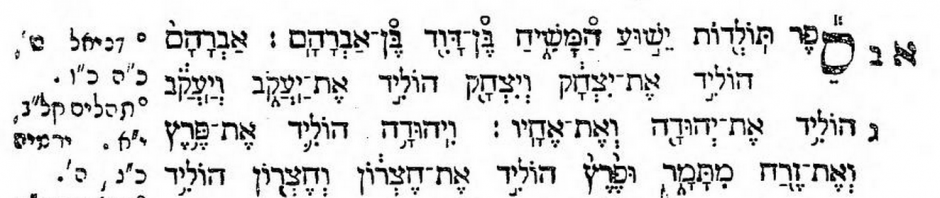
Shakespeare’s “Othello” and “Romeo and Juliet,”[443] under the titles “Itiel ha kushi” (ib., 1874; preface by P. Smolensky); and “Ram we-Yael” (ib., 1878); Tiedge’s “Urania,” under the title “Ben Koheleth” (ib., 1876, revised); and the New Testament under the title “Haberith Hahadasha.” The last mentioned translation was undertaken for the British Society in 1887; it was published posthumously under the supervision of Dr. C. D. Ginsburg at Vienna in 1886.

5385

Prayer: Thank you Lord for Isaac Salkinson, his faith in you and his language skills that have left a lasting impact on the Hebrew New Testament and modern Hebrew literature. May we be accurate and faithful translators of your Word of Truth, and sensitive interpreters of and communicators in our contemporary culture. In Yeshua’s name we pray. Amen.

images (3) 

Of Man’s First Disobedience, and the Fruit

Of that Forbidden Tree, whose mortal taste

Brought Death into the World, and all our woe,

With loss of Eden, till one greater Man

Restore us, and regain the blissful

Seat, Sing Heav’nly Muse, that on the secret top

Of Oreb, or of Sinai, didst inspire

That Shepherd, who first taught the chosen

Seed, In the Beginning how the Heav’ns and Earth

Rose out of Chaos: Or if Sion Hill

Delight thee more, and Siloa’s Brook that flow’d

Fast by the Oracle of God; I thence

Invoke thy aid to my advent’rous Song,

That with no middle flight intends to soar

Above th’ Aonian Mount, while it pursues

Things unattempted yet in Prose or Rhyme.


http://juchre.org/hcw/1872/1872-02.pdf


His most famous translations:

1871 – John Milton’s Paradise Lost as Vaygaresh et ha-adam (“And He drove the man out”, a phrase from Genesis 3:24).

The New Testament, published posthumously in 1886, although his translation is now difficult to find, as the one by Franz Delitzsch is more prevalent.

Two works by William Shakespeare: 1874 – Othello as Ithi’el ha-Kushi, and in 1878 – Romeo and Juliet as Ram ve-Ya’el.

Posted in otdimjh | 2 Comments

4 June 2008 Opposition to Messianic Jews #otdimjh

4 June 2008 CBN News Reports on Opposition to Messianic Jews #otdimj


Screen Shot 2015-06-03 at 22.18.03

Turning Up the ‘Heat’ on Messianic JewsBy Chris Mitchell

Mideast Bureau Chief, CBN News

CBNNews.com – JERUSALEM, Israel – In the latest in a growing number of incidents against Israeli Messianic Jewish believers — Jews who believe that Yeshua (Jesus, in Hebrew) is the Messiah — a group of ultra-Orthodox youth set fire to New Testaments collected from the town’s residents.

The Bible burning, which took place in Or Yehuda, a town of about 28,000 located between Tel Aviv and Ben Gurion Airport, was first reported in the Israeli daily Maariv.

According to the article, Or Yehuda’s Deputy Mayor Uzi Aharon drove through the streets, asking residents over a loudspeaker to turn over New Testaments in their possession to yeshiva (religious seminary) students.

After collecting hundreds of Bibles the next day, the students threw them in a pile next to the neighborhood synagogue and set them on fire.

Though the newspaper caught the deputy mayor on film at the bonfire, he said he came to stop the students when he saw what they were doing.

“I asked that they prepare everything in a parking lot and I planned to come with a pick up and take the substances [New Testaments] in the pickup,” he said. “When I got there, to my disappointment, a bunch of young guys spontaneously started a fire and burned some of the materials that were collected,” he said.

Aharon said “missionaries” were to blame.

“The missionaries passed out a kit, which included the New Testament and two additional booklets in a new, well-to-do neighborhood in Or Yehuda,” the deputy mayor said. “The whole essence of these pamphlets was incitement against the Jews,” he said.

Jews Appalled at the Incident

Reaction to the Bible burning was swift.

Israeli Prime Minister Ehud Olmert’s spokesman called it “a despicable act.”

The Anti-Defamation League said burning anyone’s Bible is “…a violation of basic Jewish principles and values.”

The American Jewish Committee said “no provocation can justify such outrageous behavior.”

Victor Kalisher, director of the Jerusalem Bible Society, which printed some of the New Testaments that were destroyed, called it “shocking.”

“To see that such books are being burnt, it is shocking,” Kalisher told CBN News. “As a Jew, as a son of a Holocaust survivor, when I see something like that, it only tells me that much dangerous things will probably follow,” he said.

“The burning of Christian holy books in Or Yehuda is especially worrisome in light of the continued harassment of Messianic Jews in the country,” stated an editorial in Haaretz, a prominent Israeli newspaper.

But attacks against Israeli Messianic Jews are on the increase.

A Near-Death Experience

On March 20, during the Purim holiday, Ami Ortiz, the youngest son of a Messianic pastor’s family opened a booby-trapped holiday gift box delivered to their home, triggering a powerful bomb that nearly killed him and destroyed most of the contents of their apartment.

Though he’s made miraculous strides in his recovery, this 15-year-old Israeli believer still faces a long stretch of surgeries and physical therapy.

Police suspect that anti-missionaries were behind the bombing. But after more than two months, no arrests have been made, and the family’s attorney claims police are not pursuing the investigation.

The police sought a court order to prevent Israel’s Channel 1 from broadcasting a story on the attack, which criticized their handling of the case, but the court denied the petition and the program aired last Friday evening.

“By God’s grace, it was broadcast all over the country,” David Ortiz, Ami’s father told CBN News. “People were able to see it on the Internet. It was shown on satellite TV in the States and in other places, and Israelis were able to see for the first time what actually took place in my house,” he said.

Other Incidents around the Country

There have been increasing numbers of incidents against Messianic believers, in places like the northern coastal city of Acco, Kiryat Gat, Jerusalem, and Beersheba.

The small Messianic fellowship in the southern desert city of Arad, less than 30 miles east of Beersheba, has experienced one of the most intense oppositions. Members of the Gur Hasidim, an ultra-Orthodox sect, frequently demonstrate in front of the homes of Jewish believers and at their fellowship when it meets on Shabbat (the Sabbath).

Yad L’Achim (hand to the brothers), an anti-missionary organization, works at galvanizing Israelis against the country’s Messianic Jews.

“We’re expressing protest against the fact that these people came here, people who came to this country in a problematic way, with social problems,” said Yad L’Achim activist Alex Artovski.

“And they take people from the people of Israel and make them missionaries who belong to the cult Messianic Jews,” he said.

But some Israelis find Yad L’Achim‘s demonstrations deeply disturbing.

“The Haredim are bothering them day and night and this bothers me very much because I am from a family of Holocaust survivors and my grandmother and grandfather in Poland were shouted at — ‘Jews get out,’” said Zohar Galant.

“Like this they are shouting at them now that they will get out. I, as a Jew, am embarrassed by these people who are engaging in these demonstrations and hurting innocent people,” Galant said.

Jerusalem Bible Society Director Victor Kalisher has another concern — that Israeli society will tolerate attacks against Messianic Jews.

“If the leaders of religious groups, people of leadership, people who should be a role models, are described as people who initiate and support burning of books with students dancing around it, the next day we can have people hurt, we can have windows broken, we can have a burnt shop. We cannot ignore it, we cannot think that well it’s an isolated incident,” he said. “It is not.”

Prayer: As with all acts of violence, against believers in Yeshua or anyone else, the behaviour that results from the anger of man cannot achieve the righteousness of God. Just as Yeshua prayed “Father, forgive them, they know not what they do” so we pray for those who would oppose Jewish believers in Yeshua today. Have mercy, Lord, have mercy. Amen.

Posted in otdimjh | 2 Comments

3 June 1855 Spurgeon on the return to Zion #otdimjh

3 June 1855 Charles Spurgeon preaches on the return of the Jewish people to the Land #otdimjh

195px-CHSat23

“The hour is approaching, when the tribes shall go up to their own country; when Judea, so long a bawling wilderness, shall once more blossom like the rose; when, if the temple itself be not restored, yet on Zion’s hill shall be raised some Christian building, where the chants of solemn praise shall be heard as erst of the old Psalms of David were sung in the Tabernacle. ..I think we do not attach sufficient importance to the restoration of the Jews. We do not think enough about it. But certainly, if there is anything promised in the Bible it is this. I imagine that you cannot read the Bible without seeing clearly that there is to be an actual restora­tion of the Children of Israel … For when the Jews are restored, the fullness of the Gentiles shall be gathered in; and as soon as they return, then Jesus will come upon Mount Zion with his ancients gloriously, and the halcyon days of the millennium shall then dawn; we shall then know every man to be a In-other and a friend; Christ shall rule with universal sway.”

Screen Shot 2015-06-02 at 20.56.00

From a Sermon Delivered on Sabbath Morning, June 3, 1855, by the REV. C. H. SpurgeonAt New Park Street Chapel, Southwark.

Early Life

Born in Kelvedon, Essex, Spurgeon’s conversion to Christianity came on 6 January 1850, at age 15. On his way to a scheduled appointment, a snow storm forced him to cut short his intended journey and to turn into a Primitive Methodist chapel in Colchester where God opened his heart to the salvation message. The text that moved him was Isaiah 45:22 – “Look unto me, and be ye saved, all the ends of the earth, for I am God, and there is none else.” Later that year on 4 April 1850, he was admitted to the church at Newmarket.

images (1)

His baptism followed on 3 May in the river Lark, at Isleham. Later that same year he moved to Cambridge, where he later became a Sunday school teacher. He preached his first sermon in the winter of 1850–51 in a cottage at Teversham while filling in for a friend. From the beginning of his ministry his style and ability were considered to be far above average. In the same year, he was installed as pastor of the small Baptist church at Waterbeach, Cambridgeshire, where he published his first literary work, a Gospel tract written in 1853.

images (2)

.In April 1854, after preaching three months on probation and just four years after his conversion, Spurgeon, then only 19, was called to the pastorate of London’s famed New Park Street Chapel, Southwark (formerly pastored by the Particular Baptists Benjamin Keach, theologian John Gill and John Rippon). This was the largest Baptist congregation in London at the time, although it had dwindled in numbers for several years. Spurgeon found friends in London among his fellow pastors, such as William Garrett Lewis of Westbourne Grove Church, an older man who along with Spurgeon went on to found the London Baptist Association.

263px-Charles_Haddon_Spurgeon_by_Alexander_Melville

Within a few months of Spurgeon’s arrival at Park Street, his ability as a preacher made him famous. The following year the first of his sermons in the “New Park Street Pulpit” was published. Spurgeon’s sermons were published in printed form every week and had a high circulation. By the time of his death in 1892, he had preached nearly 3,600 sermons and published 49 volumes of commentaries, sayings, anecdotes, illustrations and devotions.

375px-SpurgeonSurrey

Prayer: Thank you Lord for Spurgeon’s gifts of preaching and teaching, and his legacy that continues today. His expectation of the future of Israel maps out in broad outline a broadly historic premillennial position, which fuelled his passion for mission and ministry then and now. May Messianic Jews learn from his example, and live out their callings according to your Word. In Yeshua’s name we pray. Amen.


http://www.spurgeon.org/sermons/0028.htm

http://www.baptists4israel.co.uk/baptist%20hero.htm

http://www.spurgeongems.org/vols10-12/chs582.pdf

“Once a Curse But Now a Blessing” delivered on December 6, 1863 at the Metropolitan Tabernacle, Newington:

But the day is coming, yea it dawns already, when the whole world shall discern the true dignity of the chosen seed, and shall seek their company, because the Lord hath blessed them. In that day when Israel shall look upon him whom they have pierced, and shall mourn for their sins, the Jew shall take his true rank among the nations as an elder brother and a prince. The covenant made with Abraham, to bless all nations by his seed, is not revoked; heaven and earth shall pass away, but the chosen nation shall not be blotted out from the book of remembrance. The Lord hath not cast away his people; he has never given their mother a bill of divorcement; he has never put them away; in a little wrath he hath hidden his face from them, but with great mercies will he gather them. The natural branches shall again be engrafted into the olive together with the wild olive graftings from among the Gentiles. In the Yew, first and chiefly, shall grace triumph through the King of the Jews. 0 time, fly thou with rapid wing, and bring the auspicious day.

“The Restoration and Conversion of the Jews” delivered on June 16, 1864 at the Metropolitan Tabernacle, Newing ton:

There will be a native government again; there will again be the forma of a body politic; a state shall be incorporated, and a king shall reign. Israel has now become alienated from her own land. Her sons, though they can never forget the sacred dust of Palestine, yet die at a hopeless distance from her consecrated shores. But it shall not be so for ever, for her sons shall again rejoice in her: her land shall be called Beulah, for as a young man marrieth a virgin so shall her sons marry her. “I will place you in your own land, ” is God’s promise to them … They are to have a national prosperity which shall make them famous; nay, so glorious shall they be that Egypt, and Tyre, and Greece, and Rome, shall all forget their glory in the greater splendour of the throne of David …1 there be anything clear and plain, the literal sense and meaning.

If this passage (Ezekiel 37:1-IO) has a meaning not to be spirited or spiritualized away, it must be evident that both the two and the ten tribes of Israel are to be restored to their own land, and that a king is to rule over them.

“The Leafless Tree” delivered on March 8, 1857 at New Park Street Chapel, Southwark:

If we read the Scripture’s aright the Jews have a great deal to do with this world’s history. They shall be gathered in; Messiah shall come, the Messiah they are looking for-the same Messiah who came once shall come again shall come as they expected him to come the first time. They then thought he would come a prince to reign over them, and so he will when he comes again. He will come to be king of the Jews, and to reign over his people most gloriously; for when he comes Jew and Gentile shall have equal privileges, though there shall yet be some dis­ tinction afforded to that royal family from whose loins Jesus came; for be shall sit upon the throne of his father David, and unto him shall be gathered all nations.

Spurgeon interpreted the text quite literally, he took its promises at face value. He refused to retreat to a “spiritualized” interpretation which either negated or obfuscated what he viewed as a clear teaching of the text.

Spurgeon repeated the theme of the restoration of Israel to the land on many other occasions. He clearly linked that restoration together with the Jews national acceptance of Christ as their Messiah.

“It is certain that the Jews, as a people, will yet own Jesus of Nazareth, the Son of David as their King, and that they will return to their own land, and they shall build the old wastes, they shall raise up the former desolations, and they shall repair the old cities, the desolations of many generations.”

Regarding the restoration of national Israel to its land Spurgeon consistently and clearly taught to the following key points:

  • Israel as a nation will come to faith in Christ.
  • Israel will have a national or geo-political identity.
  • The political system will be a monarchy, “a king shall reign”
  • Israel will be in the Promised Land
  • The borders will correspond to the promises given to Abraham and David.
  • Israel will hold a special place among the nations in the millennial kingdom.
  • However, Israel remains spiritually part of the church.
  • There will be a national prosperity that will be the admiration of the world
  • That the prophecies of the Old Testament should not be handled in a non-literal fashion

See specialist web sites

spurgeon.org/misc/eschat2.htm

spurgeon.org/

wikipedia.org/wiki/Charles_Spurgeon

biblebb.com/spurgeon

wholesomewords.org/biography/biorpspurgeon

spurgeongems.org

fundamentalbaptistlinks.com

Posted in otdimjh | 2 Comments

2 June 1619 Buxtorf Attends a Circumcision #otdimjh

2 June 1619 Johannes Buxtorf , Christian Hebraist, Attends a Circumcision in Basel #otdimjh

images (85)

“The circumcision of 1619 is the best known incident in the life of Johannes Buxtorfl. While Buxtorf is clearly an exceptional figure and had unusual opportunities to work closely with Jews, his attendance at the circumcision and its consequences illustrate both the possibilities and limitations of Jewish-Christian relations during this period in Germany and Switzerland.” (Stephen G. Burnett)

EpitomeGrammaticx

BUXTORF, or Buxtorff, JOHANNES (1564-1629), German Hebrew and Rabbinic scholar, was born at Kamen in Westphalia on the 25th of December 1564. The original form of the name was Bockstrop, or Boxtrop, from which was derived the family crest, which bore the figure of a goat (Ger. Bock, he-goat). [Wikipedia]

After the death of his father, who was minister of Kamen, Buxtorf studied at Marburg and the newly-founded university of Herborn, at the latter of which C. Olevian (1536-1587) and J.P. Piscator (1546-1625) had been appointed professors of theology. At a later date Piscator received the assistance of Buxtorf in the preparation of his Latin translation of the Old Testament, published at Herborn in 1602-1603. From Herborn Buxtorf went to Heidelberg, and thence to Basel, attracted by the reputation of J.J. Grynaeus and J.G. Hospinian (1515-1575).

300px-Buxtorf

After a short residence at Basel he studied successively under H.B. Bullinger (1504-1575) at Zürich and Th. Beza at Geneva. On his return to Basel, Grynaeus, desirous that the services of so promising a scholar should be secured to the university, procured him a situation as tutor in the family of Leo Curio, son of Coelius Secundus Curio, well-known for his sufferings on account of the Reformed faith. At the instance of Grynaeus, Buxtorf undertook the duties of the Hebrew chair in the university, and discharged them for two years with such ability that at the end of that time he was unanimously appointed to the vacant office.

Johannes_Buxtorf

From this date (1591) to his death in 1629 he remained in Basel, and devoted himself with remarkable zeal to the study of Hebrew and rabbinic literature. He received into his house many learned Jews, that he might discuss his difficulties with them, and he was frequently consulted by Jews themselves on matters relating to their ceremonial law. He seems to have well deserved the title which was conferred upon him of “Master of the Rabbins.”

His partiality for Jewish society brought him, indeed, on one occasion [the circumcision on June 2 1919] into trouble with the authorities of the city, the laws against the Jews being very strict. Nevertheless, on the whole, his relations with the city of Basel were friendly. He remained firmly attached to the university which first recognized his merits, and declined two invitations from Leiden and Saumur successively. His correspondence with the most distinguished scholars of the day was very extensive; the library of the university of Basel contains a rich collection of letters, which are valuable for a literary history of the time.

Prayer: Thank you, Lord, for the life and work of Johannes Buxtorf, one of the first Christians in modern times to try to listen and learn from the Jewish people, understand their literature, and make friends with them. Help us to listen and learn from another without prejudice, and accept others as you accept us. In Yeshua’s name we pray. Amen.

http://digitalcommons.unl.edu/cgi/viewcontent.cgi?article=1124&context=classicsfacpub

http://en.wikisource.org/wiki/1911_Encyclop%C3%A6dia_Britannica/Buxtorf,_Johannes_(1564-1629)

http://digitalcommons.unl.edu/cgi/viewcontent.cgi?article=1124&context=classicsfacpub

Burnett, Stephen G., “Johannes Buxtorf I and the Circumcision Incident of 1619” (1989). Faculty Publications, Classics and Religious Studies Department. Paper 124.http://digitalcommons.unl.edu/classicsfacpub/124

From Christian Hebraism to Jewish Studies: Johannes Buxtorf (1564-1629) and Hebrew Learning in the Seventeenth Century (Studies in the History of Christian Thought)Hardcover – August, 1997

31zp0+xiLeL._SY344_BO1,204,203,200_

The Circumcision of 1619 [Stephen Burnett]

The wife of Abraham Braunschweig, a Jewish printer living in Basel, gave birth to a son. Abraham planned to have the boy circumcised and wished to invite several other Jews who lived in the area to witness the ceremony. He and Buxtorf approached Georg Martin Glaser, the city official responsible for Jewish affairs to seek his permission both to conduct the rite and to invite other Jewish guests from outside the city. Glaser agreed to both requests. The circumcision took place on June 2, 1619 and was attended by Buxtorf, the younger Ludwig Konig, Johann Kessler Sr. (who directed the printing presses for Konig) and his son Johann, as well as Heinrich a Diest, one of Buxtorfs students, in addition to the Jewish guests.

Official reaction to the circumcision was both swift and harsh. One of the city’s pastors submitted a written complaint to the city council on June 5. The council ordered that the Jews be arrested and decided to investigate the entire incident. After the first of two preliminary hearings Braunschweig’s wife and infant son were ordered to be expelled from the city.

Buxtorf feared the result of the council’s deliberations. He wrote to Waser that he had become an object of hatred for all, not only because he had witnessed the circumcision, but because he had sponsored the publication of a Jewish book. He fully expected that the three Jewish correctors would be expelled from the city and that the rabbinical Bible edition, which was nearly completed, would have to be abandoned. There were even those who felt that Buxtorf himself should be expelled from the city.

During the city council meeting of June 16 the official accusation was read to the defendants and, after hearing the testimony of the Christian defendants, the council delivered its verdict. Buxtorf, L. Konig the younger, and both Kess]ers were rebuked for having attended the circumcision, because their presence had not only strengthened the Jews in their unbelief (vis-a-vis Christianity) but had angered “many honorable people, both of spiritual and secular standing.”

Glaser was charged with exceeding his authority by allowing the circumcision to take place and by allowing other Jews to witness it. Buxtorf’s only defence was that he had sought permission for what had transpired. The council then passed sentence, fining both him and the younger Konig 100 Reichstaler each for their participation in the incident. The Kesslers were ordered to spend two days and nights in jail. Geiser was also jailed until the council could decide his case.

……Buxtorf was no less convinced than the council that Judaism was a false religion. He told Kaspar Waser that he had attended the circumcision in order to testify to his Christian faith. Either at the time of the circumcision or subsequently he had told the Jews that they were “spiritually blind” and needed a “circumcision of the heart.” He had tried also to make clear to them the grace of God through the Christian gospel. Buxtorf thought that the practice of circumcision was evidence of the Jew’s spiritual blindness, since it indicated that they still considered themselves to be God’s chosen people. They had failed to see that the Messiah had come and gone, that God’s blessing now rested on the Church, and his wrath had been poured out upon the Jews.

Nonetheless, by attending as Jewish ceremony Buxtorf did not think that he was condoning unbelief. His conscience was clear on the matter. Buxtorf’s reaction to the treatment he had received from the council and from his fellow citizens was predictable. “What an honor, what a reward for my tremendous labors!”

He was angry enough to consider leaving the city entirely to accept a professorship at Heidelberg. Buxtorf did not discuss the injustice done to Abraham Braunschweig or the other Jewish guests at the circumcision, but judging from the arrangements he made with Glaser he saw nothing wrong with Abraham’s wish to have his son circumcised. Although he disagreed with the religious significance assigned to it by Jews, he thought that so long as the ceremony was permitted by the city authorities he had no quarrel with it.

Buxtorf’s presence at the circumcision, in contrast to the council’s vindictive denunciation of it, is indicative of his correct and perhaps friendly relations with the Jews with whom he worked. According to Tossanus, Buxtorf would periodically invite Jews to eat in his home in order to discuss his questions about Jewish beliefs and practices. That these conversations. took place at all reflects the trust which Buxtorf’s Jewish aquaintances had in him as a person. One even spoke with Buxtorf about a Jewish convert who had returned to Judaism, an extremely sensitive topic. Had he been rabidly anti-Jewish they would hardly have eaten with him, much less discussed their religion. Even seen against this background of trust, however, Abraham Braunschweig’s invitation must have been an unusual gesture of friendship.

Buxtorf’s theological argument with Braunschweig is one of the two recorded instances when he ever discussed Christianity with a Jew.

Posted in otdimjh | 2 Comments

1 June 2009 Christology, Messianism and Jewish-Christian relations #otdimjh

1 June 2009 Tim Dean discusses Christology, Messianism and Jewish-Christian Relations #otdimjh


Jesus cannot be properly understood in isolation from this relationship [with the Father above]. Consequently, a Christology from below that concentrates solely on the historical Jesus is inadequate.However, a Christology from above that begins with the pre-existent Logos or divine Son, without demonstrating how a firm basis for acknowledging the divinity of the Son can be found in the mission and vocation of Jesus, is also inadequate. [Wolfhart Pannenburg in Greene:311/2]

[This insightful article discusses many aspects of christology and messianology, although it does not factor in Messianic Jewish contemporary Christology, or the work of Bauckham, Hurtado and Boyarin who see not reason why a Jewish Christology could not and cannot today affirm the divinity of Yeshua. It is cross-posted from Fulcrum]

Christology, Messianism and Jewish-Christian relations

by Tim Dean

For Christians down the ages, the foundational Christological idea that Jesus of Nazareth was the Messiah has determined the Church’s attitudes to Judaism and Jews. Jewish expectation of the coming of the Messiah proceeds unabated since the birth of Christianity. In Jewish prayer books and recited regularly in Synagogue services is Maimonides’ affirmation: ‘I believe with perfect faith in the coming of the Messiah, and, though he tarry, I wait daily for his coming.’ This essay seeks to explore one key question: How can Christians understand the persistence of Judaism and acknowledge the faithfulness to God of many Jews over the last two millennia, who nevertheless cannot accept Jesus as Messiah? This is no abstract theoretical question, but a personal pilgrimage – a lived out quest for appropriate Christian-Jewish relations that respects the integrity of both faiths.

Jewish Christology

Is there such a thing as Jewish Christology? ‘Yes’, in that Judaism does engage in questioning the nature and role of Jesus, and ‘no’, because Judaism will never use the term Christ, as it would be seen as affirming Jesus as Messiah.

So how do Jews understand ‘messiah’ and view Jesus? According to Louis Jacobs, ‘messiah’ in Hebrew Scriptures refers to anyone ‘actually anointed with sacred oil for the purpose of high office, such as the king or high priest. The term is also applied to any person for whom God has a special purpose: Cyrus, king of Persia, for instance.’ Biblical antecedents led to the development of the doctrine of the Messiah, as ‘the person believed to be sent by God to usher in a new era in which all mankind will worship the true God’ [Jacobs 1995:342] With other Rabbinical scholars, he insists the doctrine of Messiah firmly denotes a this-worldly aspect of Jewish eschatology.Thus Jewish traditions are clear in their expectations of a personal Messiah:

  • He will bring an end to oppression, gather in the Jewish exiles, rebuild the Temple, end war, and introduce a golden age of universal peace.
  • He will be a wise leader from King David’s royal household, a leader of the redeemed people, not the Redeemer – who is God alone.
  • He will bring about the resurrection of the dead.

Crucially for a Jewish evaluation of Jesus, the Messiah is not God. As Cohn-Sherbock puts it, ‘Although the Messiah was now viewed as an ideal human person who would rescue the nation, there was no expectation that he would be divine.’ [Cohn-Sherbock 2004:20]. Indeed, Jews hold that it is impossible for God to become human. The Messiah cannot forgive sins, that is God’s prerogative. David Rosen adds ‘the condition of one’s personal soul has nothing to do with the identity of the Messiah, but is a matter between the individual and God.’ [Kendal & Rosen:46]

In addition, Cohn-Sherbock notes that today, belief in the coming of a personal messiah has dwindled, with some non-Orthodox movements translating ‘belief in the Messiah into a belief in a Messianic period’. [Cohn-Sherbock 2004:20] Secular Zionism adopted elements in the Messianic tradition which were hospitable to their effort to restore the Jews to their ancient land. Later Religious Zionists, hold that while the establishment of the State of Israel cannot be identified with the Messianic hope, it is to be seen as the beginning of the redemption.(Jacobs:343)

Rejection of Jesus as Messiah, has been interpreted by some Christians as being a perverse, deliberate and malignant denial of the obvious. But in the light of this brief survey of Jewish messianic reasoning, Christians should at least acknowledge the truth of Martin Buber’s comment, ‘We, Israel, are not able to believe this.’ Why? Because messianic redemption is about a total, irreversible redemption of this world, once and for all. This is expanded upon by Schalom Ben-Chorin, ‘The concept of the redeemed soul in the midst of an unredeemed world is alien to the Jew, profoundly alien … This is the innermost reason for Israel’s rejection of Jesus, not a merely external, merely national conception of messianism. In Jewish eyes, redemption means redemption from all evil.’ [Moltmann 1994:120] So a ‘Jewish Christology’ finds no ‘Christ’ in Jesus.

The Christian response is to argue that Jesus’ messiahship was in an unexpected form as far as contemporary Jewish understanding was concerned. The particular form it took was consistent with the Hebrew scriptures, albeit based on a different interpretation of the texts.

Anti-Judaism

The Jewish inability to accept Jesus as Messiah, led to theological formulations within Christianity which developed into a profound anti-Judaism: that the Christian church has ‘superseded’ Judaism, thereby rendering it redundant in offering any hope of ‘salvation’ to Jews outside faith in Christ. As Reuther observes:

‘Anti-Judaism was the negative side of the Christian affirmation that Jesus was the Christ. … But since the Jewish religious leaders rejected this claim, the church developed a polemic against the Jews and Judaism to explain how the church could claim to be the fulfilment of a Jewish religious tradition when the Jewish religious teachers themselves denied this.’ [Reuther 1981:31]

It is important to make a distinction between anti-Judaism and anti-Semitism, though a clear distinction is not always possible. Anti-Judaism includes the negative stereotyping of Jewish religious faith, expressed in the idea of supersessionism. It is based exclusively on theological grounds. However, that religious idea took on political dimensions with the rise of Christendom when the church’s power extended to civil regulation. Arguably, it is the latter phenomenon, which helped breed anti-Semitism – an ideology of hatred of the Jewish people as an ethnic group, whose very biological make-up is seen as evil. It can also carry a ‘Christian’ motif ‘thinking of Jews today as responsible for the death of Jesus, transforming the execution of Jesus into a metaphysical act of deicide for which Jews are culpable’. [UCC:75]

Without any intention of mitigating the offence of anti-Judaism, it also needs to be marked that the antipathy of each of the two faiths has been mutual. Jewish ‘anti-Christianity’ also existed at the time of Paul and the early Church, and in later Jewish writings. But the crucial difference is in the relative power relationships between the two. When Paul was writing, the Church was in an inferior power-relation to the dominant Jewish faith; but at least from the fourth century through to the present day, the position has been reversed with Christianity dominant in relation to Judaism and exerting considerable political and social influence over Jews.
Paul

No consideration of the relationship between Christianity and Judaism can take place without considering the influence of Paul, especially his letter to the Romans. For insight into Paul’s understanding of the issues, I am focusing on Tom Wright’s commentary for these reasons: this is a substantial contemporary work on Romans fully cognisant of the Holocaust and Christian anti-Judaism; in common with many scholars since FC Baur in 1836, Wright puts chapters 9-11 at the centre of Paul’s theological treatise; and because Wright does not accept the understanding of the issue offered at this essay’s conclusion – though, arguably, his framework of understanding should allow it.

Wright is cautious about anyone claiming to have fully understood the complex thought of Romans. He is passionately trying to understand Paul’s thinking within his time and context, warning that Paul is not writing to our contemporary agendas about how all religions are basically the same, nor how the one God has made two equally valid covenants, one with Jews and the other with Christians. (Wright 2002:621)

Paul’s fundamental insights here, which have earned him much criticism from his fellow Jews from that day to this, are [1] to uncouple the Mosaic law from the Abrahamic covenant and thus [2] to regard the Abrahamic covenant as fulfilled ‘apart from the law’ (3:21); [3] to see the Torah as applying to Jews only, and hence not being relevant to the eschatological period when the Gentiles were coming in to God’s people; [4] to see the Torah as intensifying the problems of Adam’s sin for those who were ‘under the Torah’, and thus as something from which its adherents needed to be freed; and [5] to claim, nevertheless, that the Torah had been given by God, had performed the paradoxical tasks assigned to it, and now strangely fulfilled in the creation of the new people of God in Christ and by the Spirit. [Wright 2002:402]

Romans offers no other conclusion than Paul’s firm belief that Jesus was the Messiah for Jews, as well the Gentiles. Paul could not have conceived of there being two parallel covenants in operation, one for Jews, and one for the rest. ‘Any suggestion that Paul would have encountered a split, a twin-track salvation-history, in which Jews should remain Jews and Gentiles might become Christians is without the slightest foundation in his thought or writings.’ True, and Wright also observes ‘There is no easy answer to the large-scale question underneath this discussion. If there were, Paul would have given it.’ [Wright 2002: 451/2] However, it should be noted that Paul has genuine concern for his own people, and will have no thought that God has abandoned Jews, or his covenant with them. ‘All Israel will be saved.’ (Rom 11:26)

In Paul’s day, there were unresolved issues within the Christian community, crucially the question of their identity as a Jewish, or non-Jewish, entity. All the early leaders and followers of this ‘Jesus movement’ were Jews who still attended synagogue. So were they a movement within Judaism or quite separate, and if the latter would there be a continuing Judaism quite separate from the growing Christian movement?
Significantly, no-where in Romans does Paul call for the evangelisation of Jews. Indeed, much of his argument seems to be exhorting Gentile Christians in Rome not to abandon Jews, and to recognise them as the covenant people of God. ‘Has God rejected his people? By no means!’ (Rom 11:1) So why doesn’t Paul call for Jewish evangelisation? Wright offers four possible explanations. First, there is a danger that Gentile Christians in Rome will assume that God has rejected Jews for good. Secondly, Rome had a long tradition of anti-Jewish sentiment. Thirdly, after Claudius’s death in 54CE thousands of Jews returned to the capital, and so it would be easy for the small young church to feel threatened and regard them as the enemy. Finally, by the late 50s there was increasing tension in Judaea and Galilee, and Rome seemed to want to provoke a Jewish rebellion. So Gentile Christians in Rome, would be eager to distance themselves from any sense of complicity with the impending revolt. [Wright 2002:623]
Given the common understanding that Christ’s second coming was not far off, it was impossible for Paul to conceive that Judaism would be flourishing two millennia later. I have no doubt that Paul thought it essential that Jews accept Jesus was their Messiah, and expected that Jews would eventually follow suit. It is also evident that Paul thought his argument in Romans 11 would be effective: that Jews would be jealous when they saw God’s blessings within the Gentile community, and as a consequence be won over. He could not possibly have conceived that Christians would persecute Jews at various times and places throughout subsequent millennia. Thus giving Jews every reason to find the notion of their proposed jealousy utterly ludicrous – and also giving them good reason to see in the unrighteous behaviour of the Church an emptiness in the claim that Jesus is the Messiah.
Judaism, Christianity and liberation

Alongside the sometimes adverse nature of Christian-Jewish relations, there have been times and places down the ages characterised by good relations. Since the Holocaust, there have been fresh Jewish-Christian dialogues which have led to renewed interest in the ‘historical Jesus’, and a re-examination of ‘Christology from below’. However, within the Jewish community, opinions about Jesus range from those who deny his very existence through to those who accept some of the narrative history of Jesus’ life in the Gospels. And given the horrors of the Nazi era alone, it should not surprise anyone that among Jews, the fear exists that to acknowledge in any way ‘that Jesus has something of value to say to Jews, is to open the door to apostasy to a religion which Jews have given up their lives rather than embrace.’ [Jacobs:284]

Two dimensions of the renewed interest in Christian-Jewish dialogue will be mentioned here: Liberation Theology, and the Jewish faith of Jesus. In the late 1980s and early 1990s, some Jewish scholars began to articulate liberation theologies, openly building on the work of the Christian liberation theologians. Five books encapsulated the debate. The Jewish proponents were Dan Cohn-Sherbock (1987), and Marc Ellis (1987 & 1989). Those writings were followed by a collection of essays from Jews and Christians, edited by Otto Maduro (1991), plus a review of all the volumes by Cohn-Sherbock (1992).

The rich vein of common ground discovered by these Jewish authors was based on the liberationist’s emphasis on a ‘Christology from below’. These authors were able to acknowledge Jesus of Nazareth as one who stood fully in the prophetic tradition of the Hebrew scriptures: someone who acted out of the righteous tradition of the Law and the Prophets in advocating the rights of the poor, marginalised and oppressed; someone who saw this as inextricably bound up with the faithful worship of God over and against the empty behaviour, rituals and worship of some religious leaders. The attraction of Boff, Gutierrez and Sobrino, et al, is that ‘unlike theologians of the past, liberation theologians are not concerned to analyse Jesus’ dual nature as God and man; abstract speculation about the central issue of traditional theology have been set aside. Instead, liberation theology focuses on the historical Jesus … What is of crucial significance for Jewish-Christian dialogue is the primary emphasis on understanding Jesus as a first century Jew.’ [Cohn-Sherbock 1992: 9] Cohn-Sherbock recognises at the heart of Christian liberation theology there is a vision of Jesus as a prophet of Israel, calling the people back to the true worship of God. He therefore argues that Jews should not see Jesus’ departure from Jewish law as co-terminus with a rejection of Judaism, but rather as:

… a critique of religious corruption and moral stagnation. In his confrontation with the leaders of the nation, Jesus echoed the words of the prophets by denouncing hypocrisy and injustice.The love of wealth and the exploitation of the poor, he contended, made it impossible to establish a proper relationship with God. … As a prophetic figure Jesus should be recognisable to all Jews; like the prophets, he emphasised that loving-kindness is at the heart of the Jewish faith. Jesus’ words thus recalled such figures as Amos, Hosea, Isaiah, and Jeremiah; he stood firmly in the Jewish tradition. [Cohn-Sherbock 1992:38]

In the Christology from above and below debate, orthodox Christian belief sees them as two sides of the same coin. Wolfhart Pannenburg argues that:

Jesus cannot be properly understood in isolation from this relationship. Consequently, a Christology from below that concentrates solely on the historical Jesus is inadequate.However, a Christology from above that begins with the pre-existent Logos or divine Son, without demonstrating how a firm basis for acknowledging the divinity of the Son can be found in the mission and vocation of Jesus, is also inadequate. [Greene:311/2]

Pannenburg also observes that there is a danger in a ‘from above’ approach to Christology in that it ‘tends to overlook the historical particularity of the man Jesus, his relationship to the God whose kingdom he proclaimed and his setting within the Judaism of his time.’ [Greene:18]The problem is one of emphasis. Where Christian engagement with Judaism is concerned, I believe relationships have been impaired precisely because the Church at times over-emphasised a Christology ‘from above’ in thought, worship and practice. In this light it’s significant that Jewish engagement with liberation theology has welcomed its emphasis on Christology from below. For it focuses on the ‘this-worldly’ activity of Jesus in the prophetic tradition, with his liberating emphasis on justice and freedom from oppression being at the heart of the Law.

Albrecht Ritschl’s concept of Christology as ‘from below to above’ is a corrective to much Christian thought and practice. We must surely understand Jesus in the manner of God’s revelation to humankind in history – engaging first with Jesus’ Jewish humanity, and seeing in that historic person the expression of deity and God’s commitment to all humankind. A too exclusive focus on Christology from above has created an over-emphasis on the transcendental nature of Christianity – the supernatural at the expense of the natural – which becomes expressed in Christian sacramentalist rituals that disembody Jesus of Nazareth from ‘Christ’.Thus, it loses the dynamic ‘Jewishness’ of Jesus, his understanding of God revealed in the Hebrew Scriptures, and Jesus’ commitment to the Torah and Prophets. It further divides the Christian community from its Jewish heritage. As Colin Greene observes:

A Christ who is emptied of Jesus of Nazareth and becomes a supernatural deityother becomes not only removed from the stuff of life with its urgent concerns for just and moral behaviour, but it also becomes removed from Jesus the Jew whose ‘Christ-ness’ is dislocated from the very religiouscultural world which informs and explains the notion of ‘Messiah’. [Greene:19]

When such a ‘disembodied Christ’ comes to ascendancy in the Church, it has reinforced one of the long held Jewish objections to Christian life and practice. Rightly so. Cohn-Sherbock reiterates that Jewish objection:

… the fervent Jewish expectation of a total transformation of the world was replaced by a spiritualized and individualised hope for immortal, celestial life. The reign of God … appeared as a heavenly promise that offered salvation for the individual. Within this framework, the temporal world was understood as having only preparatory value. (…) This concept of an internalised and spiritualised Kingdom of God has worked throughout history as a deterrent for Christian action. [Cohn-Sherbock 1992:15/16]

Looking afresh at the historical Jesus, can lead to a renewed understanding of the Jewish faith of Jesus, and his relations with Jewish religious authorities. One of the issues identified as needing revision by Cohn-Sherbock, Reuther, Rosen, et al, is Christian attitudes to Pharisees.This is important for two reasons: because Jesus’ denunciations of some Pharisees are used by some Christian in their claim that God sent Jesus as Messiah because of Jewish religious failure; and because the Pharisees are the predecessors of today’s Rabbinic Judaism.

Part of the issue is the extent to which people want to argue that Jesus’ attacks on Pharisees were either: 1] specific charges brought against specific individuals, specific leaders collectively, at a particular place and point in time; or 2] a thorough denunciation of all Pharisees, their institutions and everything they ever stood for. Within Jewish-Christian relations, the question of the Pharisees can tend to polarise – with Christians who hold to the second viewpoint being met by an equally untenable view that the Gospel writers accounts of Pharisees cannot possibly be true. Support for the first interpretation comes from Matthew in what is seen to be the most virulent attack on Pharisees by Jesus – the ‘seven woes’ in chapter 23. As Luz points out, these are qualified by verse 2 where Jesus says ‘the Pharisees sit on Moses’ seat; therefore do whatever they teach you and follow it; but do not do as they do, for they do not practice what they preach.’ (NRSV)

Matthew consistently lays stress on their (Pharisees) practices rather than their doctrines. … their words fail to match their deeds. That the disciples must ‘do everything they tell you’ (23:2) is, of course, hyperbole that, rhetorically, reaffirms the main thrust of Matthew’s Gospel, the emphasis of practice over theory. [Luz 1995:122]

Some Jewish scholars are quite prepared to recognise that the Pharisees Jesus addressed were either as corrupt or hypocritical as Jesus described, or were at least capable of being so. David Rosen sees a very important distinction between those Pharisees Jesus is recorded as addressing and Pharisees as they are to be truly understood (Kendall & Rosen 2006:3), and the Jewish scholars engaged in dialogue on Liberation Theology have no difficulty in acknowledging corruption in the Jewish leadership which Jesus confronted.

It is also true to assert as Jacobs does that ‘Christianity itself owes much to the Pharisaic background of Jesus – the Christian doctrine of the Hereafter and the resurrection of the dead, for instance.’[Jacobs:376] Reuther argues that Pharisees such as Hillel ‘were making some of the same interpretations of the law as Jesus did’. [Reuther 1981:37]

More than that the Church must not lose sight of Jesus’ total commitment to the Jewish faith and its heritage. So when Jesus attacked money-changers in the Temple, it was not an attack on the Templeitself, or the Hebrew faith, rather an attack on corruption and an affirmation of the sanctity and significance of the Temple. Christianity must also affirm that it is Jewish. Not in the sense that any branch of Judaism wants to claim Christianity as its own. Rather, that Christianity is formed of Jewish faith and culture, gets its paramount theme, ‘messiah’ from it (without which, by definition, Christianity cannot be understood).
Patronising generosity

As David Goldberg has observed, ‘Monotheism, by definition is triumphalist. Judaism says weare the Chosen People. Christianity asserts that there is no salvation out side the Church. Islam says there is no God but Allah, and Mohammed is the last and greatest of all the prophets.’ [1]Within those triumphalist affirmations, which appear to assert each faith’s exclusive hold of the overall meta-narrative of human history, each faith continues to develop frameworks for understanding the other – some negative and others affirmative.
Judaism has a long tradition of acknowledging that Gentiles can have a place in the life of God and the world to come. Essentially there are two ways of being righteous, for Jews it is summed up in the Abrahamic covenant and Mosaic laws, formulated as observing 613 commandments.For the Gentiles there is the Noahide Covenant which ‘reflects God’s commitment to care for all humanity and not destroy it (Gen. 9:9-11). In return He expects all humanity to lead a moral life (Gen. 9:4-6)’, which is set out in the seven Noahide laws consisting of ‘the prohibition of idolatry, blasphemy, murder, adultery and incest (counted as one), robbery, the need to establish a proper system of justice, and the prohibition of eating flesh torn from a living animal.’ [Jacobs: 366] In addition, despite Jews regarding Christians as having ‘usurped’ the concept of ‘messiah’ and wrongly ascribed it to Christ, many are able to echo Maimonides infamous remark ‘All these activities of Jesus the Christian … are all for the purpose of paving the way for the true King Messiah, and preparing the entire world to worship God together.’ [Melamed] ‘Infamous’, because the remark only appears in uncensored manuscripts. [Goldberg 1989:279]
So how does Christian theology deal with Judaism? In very broad terms, Christians have responded in four different ways:

  1. To assert, there is no salvation apart from personal faith in Christ, and every person must declare a personal faith allegiance in Jesus the Messiah, with no exception for Jews.
  2. God has two covenants with humankind in parallel operation, one for Jews and another for the Gentiles. Such views can range from: the idea that Jesus wasis the only Messiah, but Jews who don’t recognise the fact may still be redeemed by observance of the Abrahamic covenant, through to the view that there is one Messiah for the Jews, and another for Gentiles – Jesus.
  3. There is only one covenant, but two expressions – Jewish and Christian, and ultimately Jesus will be seen by all to be the one Messiah of God.
  4. Christianity has got its Christology wrong. Jesus never claimed to be the Messiah, and his later followers – especially Paul – wrongly bequeathed that title upon him posthumously.

In rejecting 1, 2 and 4, my Christian framework is this: the Hebrew Scriptures distinguish between faithful and unfaithful people within the covenant community. The Christian conviction is that Jesus Christ in his death and resurrection, is the single agency for the salvation of all faithful people, and will present them as holy before God, and that this applies to all the departed of Israel before the advent of Jesus. Paul’s affirmation ‘All Israel will be saved’ applies to all faithful Jews in every age – those who in their lifetime believe that Jesus was their Messiah, as well as those who for the reasons outlined above, do not. This is not about two covenants in parallel operation, but rather one covenant with two expressions. To use Paul’s analogy, the Christian community is the branch grafted onto the tree of the Abrahamic covenant.

It is no use Judaism and Christianity pretending to be what they are not for the sake of ‘good’ relations. It is more helpful when they state their disagreements honestly, yet show how their own faith desires to accommodate a positive understanding of the other. The two contrary Jewish and Christian frameworks, can be seen as ‘generous’ by those disposed to do so, because at least they acknowledge the genuine faith in the one true God. Such ‘generosity’ I believe allows for creative, productive and positive relations without fudging or denying the integrity of the other – as long as we recognise the inherent ‘patronising’ nature of such frameworks, as one side seeks to affirm the other in a framework the other can’t accept.
Judaism and Christianity have two very important things in common. Both communities throughout their history, have not only brought much good and blessing to humankind, but also have had monumental failures, corruption and disobedience – which both should humbly acknowledge. Both await the coming of the Messiah – Jews for the first time, Christians for a second. Arguably, both have a shared vision of the nature and manner of human redemption when the Messiah comes.
That said and done, while it is vitally necessary for faith communities to always have frameworks for understanding, the real question is: Who is doing the judging? We must avoid the danger of appropriating the sole prerogative of God: it is for Him to judge.

Prayer: Thank you Lord for the challenges posed in this article, to truly develop a Messianic Jewish Christology that relates the nature, being and activity of Yeshua in both Jewish and Christian contexts. Please give us your wisdom and understanding that we may more closely follow your truth. In Yeshua’s name we pray. Amen.

Footnotes:

1From a conversation on March 7th 2006 with David J. Goldberg OBE who is Rabbi Emeritus of the Liberal Jewish Synagogue in St. John’s Wood, London.

Bibliography:

Bosch, D. J. (1991) Transforming Mission: Paradigm Shifts in Theology of Mission New York: Orbis Books

Cantor, N. (1995) The Sacred Chain: A History of the Jews London: Fontana Press.

Cohn-Sherbock, D. (1987) On Earth as it is in Heaven: Jews, Christians and Liberation TheologyMaryknoll, New York: Orbis Books.

Cohn-Sherbock, D. (1992a) Exodus: An Agenda for Jewish-Christian Dialogue London: Bellew Publishing.

Cohn-Sherbock, D. (1992b) Israel: The History of an Idea London: SPCK.

Cohn-Sherbock, D. and L. (2004) An Encyclopedia of Judaism and Christianity London: Darton, Longman & Todd.

Cousar, C. B. (1996) The Letters of Paul Nashville: Abingdon

Deibert, R. I. (2002) ‘The Justification of Covenantal Nomism: Reflections on Justification and Variegated Nomism, its Editorial Conclusions, and Pauline Theology’ (Cambridge NT PhD Seminar, 24/06/02) Available at:http://www.tyndale.cam.ac.uk/Tyndale/staff/Head/JVN Reflections for PDF.pdf

Ellis, M. H. (1987) Towards a Jewish Theology of Liberation Maryknoll, New York: Orbis Books.

Ellis, M. H. (1989) Towards a Jewish Theology of Liberation: The Uprising and the Future Maryknoll,New York: Orbis Books.

Epstein, I. (Ed.), Freedman, H. & Schacter, J. (Trs.) Sanhedrin (Babylonian Talmud: Tractate Sanhedrin, Chapter XI, Folios 97-99), Available at: http://www.come-and-hear.com/sanhedrin

France, R. T. (1980) ‘Messiah: In the New Testament’ in Douglas, J. D. et al, Eds. The Illustrated Bible Dictionary Part 2 Leicester: IVP; Wheaton: Tyndale House; Hodder & Stoughton: Sydney &Auckland.

Gager, J. G. (2000) ‘Paul’s contradictions – Can they be resolved?’ Bible Review 14 p32-39, Biblical Archaeology Society. Available at: http://www.jcrelations.net/en/?item=747

Goldberg, D. J., & Rayner, J. D. (1989) The Jewish People: Their History and their Religion London: Penguin Books.

Goldsmith, M. F. (1988) ‘Judaism and Christianity’ in Sinclair, B. F. and Wright, D. F. eds., New Dictionary of Theology Leicester: Inter-Varsity Press.

Greene, C. J. D. (2003) Christology in Cultural Perspective: Marking out the horizons Carlisle: Paternoster Press.

Jacobs, L. (1995) The Jewish Religion: A Companion Oxford: Oxford University Press.

Kelly, J. G. (1995) ‘The Cross, the Church and the Jewish People’ in Goldingay, J. ed. Atonement Today London: SPCK.

Kendall, R. T. & Rosen, D. (2006) The Christian and the Pharisee: Two outspoken religious leaders debate the road to heaven London: Hodder & Stoughton.

Kessler, E. (2002) ‘God Doesn’t Change His Choice’ Church Times 08/03/02, Available at:http://www.jcrelations.net/en/?item=940

de Lange, N. (1986) Judaism Oxford: Oxford University Press.

Luz, U. (1995) The Theology of the Gospel of Matthew Cambridge: Cambridge University Press.

Tim Dean is Director of the World Media Trust, and an Anglican priest working part-time in Godalming Parish. In a voluntary capacity Tim is Executive Secretary of First Step Forum (an international network of Members of Parliaments; former Prime Ministers, Foreign Affairs Ministers, and Ambassadors; and others engaged in private, independent diplomacy for religious freedom and human rights). He is also a senior associate of the Washington based Institute for Global Engagement – a ‘think-tank with legs’, created to develop sustainable environments for religious freedom worldwide. He was formerly a Commissioning Editor for the BBC World Service’s English network, and before that editor of Third Way.

http://www.fulcrum-anglican.org.uk/articles/christology-messianism-and-jewish-christian-relations/

Posted in otdimjh | 2 Comments

31 May 1934 Barth publishes Barmen Declaration #otdimjh

31 May 1934 Barmen declaration calls German Church to Resist Hitler #otdimjh

D9015-2

The Barmen Declaration or The Theological Declaration of Barmen 1934 (Die Barmer Theologische Erklärung) was a document adopted by Christians in Nazi Germany who opposed the Deutsche Christen (German Christian) movement. In the view of the delegates to the Synod that met in the city of Barmen in May, 1934, the German Christians had corrupted church government by making it subservient to the state and had introduced Nazi ideology into the German Protestant churches that contradicted the Christian gospel.

Confessing-Church-Founders

The Barmen Declaration rejects (i) the subordination of the Church to the state (8.22–3) and (ii) the subordination of the Word and Spirit to the Church. “8.27 We reject the false doctrine, as though the Church in human arrogance could place the Word and work of the Lord in the service of any arbitrarily chosen desires, purposes, and plans.” On the contrary, The Declaration proclaims that the Church “is solely Christ’s property, and that it lives and wants to live solely from his comfort and from his direction in the expectation of his appearance.” (8.17) Rejecting domestication of the Word in the Church, The Declaration points to the inalienable lordship of Jesus Christ by the Spirit and to the external character of church unity which “can come only from the Word of God in faith through the Holy Spirit. Thus alone is the Church renewed” (8.01): it submits itself explicitly and radically to Holy Scripture as God’s gracious Word.

255px-DBP_1984_1214_Barmer_Theologische_Erklärung

8.04 Try the spirits whether they are of God! Prove also the words of the Confessional Synod of the German Evangelical Church to see whether they agree with Holy Scripture and with the Confessions of the Fathers. If you find that we are speaking contrary to Scripture, then do not listen to us! But if you find that we are taking our stand upon Scripture, then let no fear or temptation keep you from treading with us the path of faith and obedience to the Word of God, in order that God’s people be of one mind upon earth and that we in faith experience what he himself has said: “I will never leave you, nor forsake you.” Therefore, “Fear not, little flock, for it is your Father’s good pleasure to give you the kingdom.

 barmen-these-then-and-now

The Declaration was mostly written by the Reformed theologian Karl Barth but underwent modification, especially with the introduction of its fifth article (on the two kingdoms), as a result of input from several Lutheran theologians.

The document became the chief confessional document of the so-called Confessing Church. The ecumenical nature of the Declaration can be seen by its inclusion in the Constitution of the Presbyterian Church (U.S.A.) and the Book of Order of the world wide Moravian Unity, the Unitas Fratrum.

One of the main purposes of the Declaration was to establish a three-church confessional consensus opposing pro-nazi “German Christianity”. These three churches were Lutheran, Reformed, and United.

Prayer: Thank you Lord for the courage of Karl Barth, Dietrich Bonhoeffer and others who saw the need to proclaim your sovereignty over against all human powers. For some this resistance cost their lives, yet their opposition to tyranny calls each of us in every generation to distinguish between divine and human powers. May we as Jewish believers in Yeshua make right decisions in our understanding and our involvement with all human institutions, power and states. In Yeshua’s name we pray. Amen.

https://gratiaveritaslumen.wordpress.com/tag/barmen-declaration/

http://skepticism.org/timeline/may-history/5926-german-confessing-church-releases-barmen-declaration.html

http://en.wikipedia.org/wiki/Barmen_Declaration

Posted in otdimjh | 2 Comments