5 February 1837 Bishop (Rabbi) Solomon Alexander leads Hebrew worship service #otdimj

5 February 1837 Hebrew Service Re-Established in Palestine Place, London

palestine_place

Gidney records:

After the lapse of centuries Christian worship was again held in the sacred Hebrew tongue, by the establishment, on February 5th, 1837, of a regular Hebrew Service in Palestine Place on Sunday afternoon. The prayers were read on that day by [Alexander] McCaul, and the sermon preached by [Bishop Solomon] Alexander from Romans xi. 14. Hebrew Christians joined with Gentile Christians in worshipping the redeemer of Israel in the language of their forefathers.

Screen Shot 2015-02-04 at 20.36.06

By the end of this year 246 Jews had been baptized in the Society’s church. The results of the London
 work were, on the whole, very encouraging; the weekly Hebrew service, besides being increasingly attended by Jewish Christians, drew a small congregation of resident Jews, and also formed a point of attraction for foreign Jews visiting the country.

Preface

Screen Shot 2015-02-04 at 20.36.55

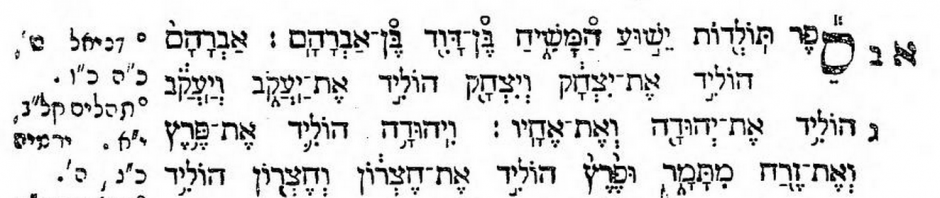
Another most important event was the publication, in 1837, by the Society, of the Liturgy of the Church of England in Hebrew, a copy of which was presented to each of the Arch- bishops and Bishops of the United Kingdom, as well as to other learned divines and scholars, from whom were received many important testimonies to the accuracy of the translation.

Missionaries of the Society, too, have testified again and again to the extreme usefulness of this Hebrew version of our Prayer Book, which has enabled services to be held in that language in the Society’s churches in London and Jerusalem, and has been a standing witness to the Jew of the simplicity, the purity, and the Scriptural character of Divine worship according to the rites of that Church of which the Society’s missionaries are ministers. This is no small matter with a people who are greatly averse to savours, however slightly, of idolatry.

The Lord's Prayer

Avinu shebashamayim. Yitkadesh sh’mecha. Tavo malchutecha. Y’hi r’tsoncha k’vashamayim k’va’aretz. Teyn lanu hayom lechem chukeynu. Us’lach lanu et-chovoteynu. Ka’asher anachnu sol’him lchayavenu. V’al t’vieynu lidei nisayon ki im haltseynu meyra’. Ki l’cha hammam’lcha v’hag’vourah v’hatipheret l’olamim. Amen

The Creed

The Creed

Prayer: Avinu shebashamayim. Yitkadesh sh’mecha. Tavo malchutecha. Y’hi r’tsoncha k’vashamayim k’va’aretz. Teyn lanu hayom lechem chukeynu. Us’lach lanu et-chovoteynu. Ka’asher anachnu sol’him lchayavenu. V’al t’vieynu lidei nisayon ki im haltseynu meyra’. Ki l’cha hammam’lcha v’hag’vourah v’hatipheret l’olamim. Amen

Thank you Lord for these early beginnings of Messianic Jewish liturgy in modern times. The whole Messianic movement is indebted to these Anglican liturgiologists. May those who worship you do so in Spirit and in truth, with a broken and contrite heart. Help us to worship you as you deserve. In Yeshua’s name we pray. Amen.

Posted in otdimjh | Tagged , , , , , | 1 Comment

4 February 1683 Birth of Rabbi Judah Monis #otdimjh

4 February 1683 Birth of Rabbi Judah Monis, First Instructor and Hebrew Grammarian at Harvard

monis book

Judah Monis (1683-1764), a Jewish scholar and educator, was an instructor of Hebrew at Harvard College between 1722 and 1760. Monis was instrumental in importing Hebrew type to the colonies, and in 1735, he published the first Hebrew textbook in America.

1735_Grammar_of_Hebrew_by_Judah_Monis

Monis was born on February 4, 1683, likely in Italy or the Barbary States. He was educated at Jewish academies in Leghorn, Italy and Amsterdam, Holland. Monis immigrated to New York City in the early 1700s, and later moved to Massachusetts where he petitioned the Harvard Corporation in 1720 to appoint him an instructor of Hebrew.

Screen Shot 2015-02-03 at 18.40.37

On March 27, 1722, Monis converted to Christianity and was baptized in a public ceremony at Harvard.

A month later, on April 30, 1722, the Corporation appointed Monis an “instructor of the Hebrew Language.” In 1723, Monis received an AM from Harvard, becoming the first Jewish person to receive an advanced degree in the colonies. Beginning in the mid 1720s, Monis worked to secure funding to print a Hebrew grammar book he had compiled. Finally, in 1735, with the financial support of the Corporation, Monis published the first Hebrew textbook in America: Dickdook leshon gnebreet, A Grammar of the Hebrew tongue.

While administrators considered Hebrew an important part of the Harvard curriculum, the subject was unpopular among students and Monis struggled with his reputation as an ineffective teacher and disciplinarian. Monis taught at Harvard for almost forty years, but his teaching responsibilities waned over time. Monis had married Abigail Marret (d. 1760) in 1724, and in 1760, Monis retired from Harvard and went to live with his brother-in-law John Martyn, minister of the second parish in Westboro, Mass. Monis died on April 25, 1764.

judah monis grave

Inscription:
Here lies buried the remains of RABBI
JUDAH MONIS, MA, late HEBREW
instructor at HARVARD College in
Cambridge in which office he continued 40
years. He was by Birth and Religion a Jew but
embraced the Christian faith and was publicly
baptized at Cambridge, AD 1722 and
departed this life April 25, 1764 Aged
81 years 2 months and 21 days.

Monis is buried in a churchyard in Northboro, Massachusetts. Using the Christian image of a grafted tree for conversion, the inscription reads in part:

“A native branch of Jacob see. 
Which once from off its olive brook
Regrafted, from the living tree.”

So on March 27, 1722, Judah Monis (1683-1764) awoke as a Jew. That evening, he fell asleep as a Christian. Witnesses to his conversion in Cambridge, Massachusetts were swept up in the occasion, as it was touted by Puritan leaders as an incredible affair. After all, it was not often that a Jew was willing to convert to Puritanism, a religion whose very deinition included strict and disciplined observance of Christian law. A lesser known, but equally important, characteristic of this group was an intense yearning to create a land founded on the principles of the Old Testament, where Puritans sought salvation by living as New Israelites. yet this embrace of ancient biblical law proved problematic for these insular, religious leaders of Puritan society who struggled to create a closer connection with God through the Old Testament, but without the proper knowledge to do so. When he moved to Cambridge in 1720 to assume a position at Harvard as the instructor of Hebrew, Monis seemed to be the perfect answer to this conundrum. Monis, a Jewish immigrant with scholarly knowledge of the Old Testament and the Hebrew language, provided a vital opportunity for the Puritans to learn Hebrew and the Bible from an authentic source and his subsequent conversion to Christianity solved the Puritan hesitance and distrust of outsiders. The embrace and acceptance of Monis in the Puritan community highlights their profound desire to achieve a more pure, divine state in the Massachusetts colony. As a former Jew, Monis became the primary link between the original language of the Holy Scripture, along with the laws and customs of the Israelites, and the Puritans of New England. Understanding God through the Old Testament in its original state was such an important task that Puritans celebrated Monis’s Jewish background, rather than demeaning it. The Puritan desire to become closer to God created the opportunity for Monis to acculturate into an otherwise extremely isolated society. Although this acculturation was dependent on his conversion, Monis entered the Puritan community of Massachusetts at an optimal time; because of the obsession of Puritan elites to transform themselves into New Israelites, particularly through the study of the Old Testament in Hebrew and applying those laws and practices to their daily lives, there was a distinct need for a authentic Hebrew teacher who would be able to ensure that future generations could continue to embrace the principles and practices of Puritan Hebraism.

Benjamin Colman

Judah Monis’s conversion, as highlighted through the discourse of Benjamin Colman, brought to light the values and priorities of, and the problems facing the Christian comunity of Cambridge. The role of Colman’s discourse was to not only deliver an oration on the necessity of the salvation of the Jews (meaning their conversion to Christianity), but also to attest to Monis’s morals and his willingness to act as a true Christian. On only the second page of his address, Colman put forth his hope that Monis “may minister unto the conversion of his Brethren; who were once the peculiar people of God and still beloved for the Father’s sake.”11 It is evident that Colman and other spiritual leaders hoped that Monis would be the catalyst in a more signiicant Jewish conversion, perhaps not unlike the mass conversion of Jewish children in Berlin, an event about which Cotton Mather wrote and spoke of often, and one that proved miraculous and wondrous in his eyes.12 Towards the end of his discourse, Colman again highlighted conversion of Jews as a necessary step on the path towards salvation.

On March 27, 1722 Monis was publicly baptized in the College Hall at Cambridge, at which time the Reverend Benjamin Colman delivered A Discourse… Before the Baptism of R. Judah Monis, to which were added Three Discourses, Written by Mr. Monis himself, The Truth, The Whole Truth, Nothing but the Truth. One of which was deliver’d by him at his Baptism (Boston, 1722). Monis’ essays are an apology and defense of his new faith, and in support of the doctrine of the Trinity drawn from “the Old Testament, and with the Authority of the Cabalistical Rabbies, Ancient and Modern.” Monis argues here for the divinity of Messiah, not only with the authority of the sacred oracles, but even by the opinion of the Jewish authors of old; and answers all the objections that the discourse brings forth out of Isai. 9. 6,7; concluding with a word of exhortation. These may be found on the web at

Monis’ Christian peers seem to have been sceptical of the sincerity of his faith, according to Hannah Adams; well they may have, as it certainly suited his career at the time to be a Christian. The fact that he also continued to observe the Shabbat (the seventh day) rather than the Sunday, rendered him suspect in their eyes.

However, Monis had been corresponding with leading Puritan ministers since his arrival in New York, on such subjects as the kabbalah, the trinity and Christian doctrine.  He studied the Bible with Cambridge ministers.  So his so-called “conversion of convenience” seems to have been the climax of years of study and thought.  De le Roi, the historian of Jewish missions in the 18th century, describes him as a thoroughly sincere and thoughtful man, and believed himself that Monis was a true believer. The Jewish community in Europe was outraged and dismayed at his acceptance of Jesus as Messiah and what they saw to be a foreign religion; but Monis insisted that he had become a Christian out of true conviction, and not for opportunism.

When Judah Monis entered the Church on the morning of his conversion in 1722, it is doubtful that he anticipated the long, fulfilling, and at times, tumultuous and challenging career that lay ahead of him at Harvard. Marked by oscillating interest and support from the university, Monis’s tenure at Harvard was not an easy one; however, he was able to leave a lasting impact in the form of his Grammar, the teaching of his students, and a tenacity and passion for the Hebrew language that has remained his legacy. The study of Judah Monis and his contributions to scholarship of the Hebrew language and Christian Hebraism highlights the role of Hebraic influence in colonial North America and traces the development of Hebrew as a cornerstone for classicism in higher education in New England and beyond. Monis is by no means a household name; however his trajectory is not uncommon among immigrants to this country – coming to the colonies to gain religious and professional freedoms, and making personal choices about his religion and his lifestyle that he believed would further his professional ambitions and allowed him to more easily assimilate into the majority culture of Puritan New England.

While he remains to this day an inherently Jewish figure, Monis blurred the lines between Christianity and Judaism and believed that Hebrew scholarship was beneficial to both groups. His passion lay in the study of Hebrew and he was determined to teach and codify the language to the best of his ability in order to ensure the passing of knowledge to future generations. Hebrew was an integral part of the system of higher education in the colonies that was ensured and enhanced by Monis’s works and his ability to promote them. While his impact might not be tangibly felt in the literature and scholarship of Hebrew today, he helped to sculpt Hebraic scholarship in the colonies, whose legacy continues to this day.

Prayer and Reflection: Such were the times that Monis lived in, the inequalities that prevented our people from entering into the fields of higher education, university life, academic teaching, and wider society, that it is little wonder that his ‘conversion from Jew to Christian’ was misunderstood, held suspect, and his motives impugned. Who are we to judge? You alone, O Lord, know the secrets of our hearts. Perhaps the blindness and error is more on the side of those who thought it incongruous for Jewish people to know their Messiah and remain Jews, as Monis appeared to do, keeping the Sabbath and other aspects of Jewish life and identity. Lord, please help us to walk in the integrity of character and faith that you desire in your Word, and help us to walk in the ways of Yeshua, the Jewish Messiah and Saviour of all nations. In his name we pray. Amen.

Sources:

Doria Charlson, Judah Monis and Puritan Hebraism

https://www.academia.edu/4027441/Judah_Monis_and_Puritan_Hebraism

http://www.ha-gefen.org.il/len/aalphabetic%20presentation/c13764/131781.php

http://archive.org/stream/jstor-527966/527966_djvu.txt

THE AMERICAN JOURNAL OF SEMITIC LANGUAGES AND LITERATURES Volume XIV. JULY 1898 Number 4 JUDAH MONIS, M.A., THE FIEST INSTRUCTOR IN HEBEEW AT HARVARD UNIVERSITY (168»-n64). By George Alexander Kohdt, Rabbi in Dallas, Texas.

Goldman, Shalom. God’s Sacred Tongue: Hebrew & the American Imaginations. UNC Press, 2004.

Karp, Abraham J., From the Ends of the Earth: Judaic Treasures of the Library of Congress, (DC: Library of Congress, 1991).

Monis, Judah, The Truth, the Whole Truth and Nothing but the Truth. Boston : Printed for Daniel Henchman, and sold at his shop, 1722.

Monis, Judah. Grammar of the holy tongue. [microform] : Proposals for printing by subscription, a Hebrew grammar … by … Judah Monis, M.A[.] teacher of the Hebrew tongue at Harvard College in Cambridge, New England. …

Colman, Benjamin A discourse had in the College-Hall at Cambridge, March 27. 1722. Before the baptism of R. Judah Monis. [microform] / By Benj. Colman, V.D.M. ; To which are added three discourses written by Mr. Monis himself, The truth, The whole truth, and, Nothing but the truth. One of which was deliver’d by him at his baptism. Boston : Printed [by Samuel Kneeland] for Daniel Henchman, and sold at his shop over against the Old Brick Church in Cornhill, 1722.

Kohut, George Alexander. Judah Monis, M.A., the First Instructor in Hebrew at Harvard University (1683-1764) in The American Journal of Semitic Languages and Literatures, Vol. 14, No. 4 (Jul., 1898) pp. 217-226. Published by: The University of Chicago Press; Stable URL: http://www.jstor.org/stable/527966

Reiss, Oscar. The Jews in Colonial America. McFarland & Company, 2004.

Sarna, Jonathan D.; Smith, Ellen; Kosofsky, Scott-Martin. The Jews of Boston. Yale University Press, 2005.

Wilson, Marvin R. Our Father Abraham: Jewish Roots of the Christian Faith. Wm. B. Eerdmans Publishing, 1989.

http://www.americanantiquarian.org/proceedings/44525182.pdf

The whole truth being a short essay, wherein the author discovers what may be the true reason why the Jewish nation are not as yet converted to Christianity, besides what others have said before him. And likewise, he proves the divinity of Christ, not only with the authority of the sacred oracles, but even by the opinion of the Jewish authors of old; and answers all the objections that the discourse brings forth out of Isai. 9. 6,7. Concluding with a word of exhortation. By R. Judah Monis

Inscription:
Here lies buried the remains of RABBI
JUDAH MONIS, MA, late HEBREW
instructor at HARVARD College in
Cambridge in which office he continued 40
years. He was by Birth and Religion a Jew but
embraced the Christian faith and was publicly
baptized at Cambridge, AD 1722 and
departed this life April 25, 1764 Aged
81 years 2 months and 21 days.
Posted in otdimjh | Tagged , , , | Leave a comment

3 February 1740 King of Naples invites Jews to return to Sicily #otdimjh 

sicily

On February 3, 1740, Charles de Bourbon, the king of Naples, issued an official invitation to the Jews to return to Sicily. They had been expelled in 1493, but many thousands of conversos had remained, practicing Jewish customs in secret, living outwardly as Christians.

bourbon

Also known as Charles VII of Naples, Charles V of Sicily and Charles III of Spain, Charles was a popular and reforming king “probably the most successful European ruler of his generation. He had provided firm, consistent, intelligent leadership. He had chosen capable ministers….[his] personal life had won the respect of the people.”

On January 12, 1493, the expulsion of the Jews of Sicily took effect, some six-and-a-half months after it was proclaimed. Although several official efforts were made to attract Jews back to the island in the centuries that followed, the expulsion was essentially the end of the Jewish presence on the island.

2000px-Royal_Greater_Coat_of_Arms_of_Spain_(1761-1868_and_1874-1931)_Version_with_Golden_Fleece_and_Order_of_Charles_III_Collars.svg

At the same time, it should be noted that there are estimates that up to half of the 30,000 to 40,000 Jews who lived in Sicily at the time of the expulsion converted to Christianity, and thus were permitted to remain.

The history of Jews in Sicily goes back at least to the Second Temple period, when a large number of Jewish slaves are believed to have been brought to the island from Jerusalem, after its conquest by Pompey in 63 B.C.E. Archaeological artifacts and documents from the Cairo Geniza, among other things, testify to the Jewish presence there during the millennium-and-a-half that followed.

In 1171, the medieval Jewish traveler Benjamin of Tudela recorded the existence of a Jewish community of some 200 families in the port city of Messina, which he described as “a land full of every good thing with gardens and plantations.” It was also, he said, the spot from which “the majority of pilgims meet to embark to Jerusalem, because it’s the best point of embarkation.”

charles3

Although the fate of the Jews in Sicily varied from settlement to settlement, and from one era to another, overall the island was good to them. By 1492, there were Jews living in more than 50 different places on the island, in separate neighborhoods called “Giudeccas,” and their overall population exceeded 30,000. They had a monopoly on textile dying, and were involved in a number of other crafts. They also included scholars and physicians.

Under the reign of the Holy Roman Emperor Frederick II (reigned 1220-1250), the Jews were extended the same rights and privileges as other citizens, and even offered the emperor’s special protection against Crusader persecution.

During the 14th century, and the first half of the 15th century, Sicily had been basically an independent kingdom, although linked by family ties to the kingdom of Aragon. When Ferdinand and Isabella joined Aragon and Castile into a united kingdom in 1479, however, Sicily came under direct Spanish rule.

And when the monarchs declared their intention to expel the Jews from their kingdom, the decree applied to Sicily as well. The difference, as Italian scholar Sergio Calabrella has written, is that, “the anti-Semitism of Spain was not shared by the Sicilian people.”

When the order finally came down, nonetheless, the Jews were forbidden from leaving with more than a small number of articles of clothing, a pair of sheets, and some petty cash. All the rest of their possessions were taken by the crown or by wealthy Christian families in Sicily.

As noted, it is believed that up to 50 percent of Sicily’s Jews elected to convert; they were known as “neofiti” (neophytes), and of course included crypto-Jews who secretly tried to maintain some of the customs of the faith. Those who left initially attempted to resettle on the Italian mainland, in such southern regions as Apulia, Calabria and Naples. When they were expelled from there, they then went east to the Ottoman Empire.

Whilst the invitation was genuine and well motivated, few responded favorably to the offer, and most of those who did chose not to remain. Charles invited the Jews to return to Sicily in hopes that this would restore flagging trade and commerce industries. Approximately 20 families heeded the call but due in part to an inhospitable welcome by the local community, most soon left.

Prayer: We continue to observe the long-term effects of anti-judaism and anti-semitism today, in a Europe that has seen the disastrous effects of singling out the Jewish people for oppression, blame and exile. Lord, have mercy! Help us to renew and reclaim our histories of prejudice, tainted with the ‘teaching of contempt”. Rather, give us the ability to welcome and accept the stranger, as you have welcomed us into your fellowship. In Yeshua’s name. Amen.

http://en.wikipedia.org/wiki/Charles_III_of_Spain

http://www.haaretz.com/news/features/this-day-in-jewish-history/.premium-1.568149

http://www.hum.huji.ac.il/upload/_FILE_1379397942.pdf

Kevin Ingram (ed.): The Conversos and Moriscos in Late Medieval Spain and Beyond review at http://www.sehepunkte.de/2011/07/18219.html

Screen Shot 2015-02-02 at 18.00.31

Screen Shot 2015-02-02 at 18.00.46

Screen Shot 2015-02-02 at 18.00.57

Posted in otdimjh | Tagged , , , , | Leave a comment

2 February 1208 Birth of James 1 of Aragon, convenor of the Barcelona Disputation #otdimjh 

300px-Jaume_I_Palma

James I (2 February 1208 – 27 July 1276) was King of Aragon, Valencia and Majorca, Count of Barcelona and Lord of Montpellier from 1213 to 1276. His long reign saw the expansion of the House of Aragón on all sides: into Valencia to the south, Languedoc to the north, and the Balearic Islands to the east. By a treaty with Louis IX of France, he wrested the county of Barcelona from nominal French suzerainty and integrated it into his crown. His part in the Reconquista was similar in Mediterranean Spain to that of his contemporary Ferdinand III of Castile in Andalusia.

340px-Jaime_I_de_Aragón_01

As a legislator and organiser, he occupies a high place among the Spanish kings. James compiled the Llibre del Consulat de Mar, which governed maritime trade and helped establish Catalan supremacy in the western Mediterranean. He was an important figure in the development of Catalan, sponsoring Catalan literature and writing a quasi-autobiographical chronicle of his reign: the Llibre dels fets.

Screen Shot 2015-02-01 at 17.48.12

James forced Nachmanides (Rabbi Moses ben Nachman) to participate in a public debate, with the Jewish convert to Christianity, Pablo Christiani. Unlike what usually happened, Nachmanides chose to respond aggressively. His defense of Judaism and refutations of Christianity’s claims served as the basis of many such future disputations through the generations. Because his victory was an insult to the king’s religion, Nachmanides was forced to flee Spain. There were those who wanted the sage killed, but James let him escape; a silent acknowledgement of the strength of the Rabbi’s arguments.

Screen Shot 2015-02-02 at 08.42.51

Prayer: In the times of James there was little room for tolerance or mutual understanding.The asymmetries of power put Jewish people at a disadvantage, and Jewish believers in Yeshua had to show their loyalty to the Church by attacking Jews and Judaism. Father, forgive! Help us to show the love of Yeshua not through forced disputations or the might of arms, but through the self-giving love of Yeshua, who humbled himself for our sakes, and chose a humiliating death on the cross to show the powers of this world their powerlessness and his true strength. In Yeshua’s name we pray. Amen.

Sources:

Richard Harvey, Raymundus Martini – The Life and Times of a Medieval Controversialist.

https://www.youtube.com/watch?v=VWeHBaHyoOY

http://en.wikipedia.org/wiki/Disputation_of_Barcelona

http://web.archive.org/web/20100114093220/http://medspains.stanford.edu/demo/barcelona/disputation.html

https://docs.google.com/document/d/1FofW6cgb4OK-7oE6BUJvkt3_dn8Q5AKaYjuDWiiWGVg/pub

http://rygb.blogspot.co.uk/2013/01/the-disputation-on-youtube.html

Posted in otdimjh | Tagged , , , | 1 Comment

1 February 1882 French Catholic Paper Complains against Jews #otdimjh


The French Catholic newspaper La Croix publishes an article by Father Francois Picard, head of the Assumptionist order behind the journal, declaring that Jewish bankers and that they are behind all of Europe’s problems. (post from Skepticism.org)

bpt6k503606z

Picard writes:

“To whom do the treasuries of Prussia, of Austria, of the German provinces belong? To the Jewish bankers of Frankfurt, Vienna, and Berlin.”

The increasing influence of synagogues cause the

“financial disasters that befall so many families …showing us the all-powerful Jew atop his golden throne and modern societies under the yoke of this gutless king. What do the collapse of nations, the destruction of families, people’s desperation, and the raft of suicides matter to him? The Jew …seeks financial monopoly. He stops at nothing to obtain it.”

The claim that Jews own everything, and furthermore that they acquired their possessions through fraud and deception, is a popular one among anti-Semites. It will often be used as an excuse to take property away from Jews – after all, since they essentially stole it from Christians originally, it’s simply a form of self-defense for Christians to take it all back.

Father Francois Picard goes on to say:

“The Jew is everywhere a Jew and nothing but a Jew.”

Traditional Catholic anti-Semitism is supposed to be entirely religious in nature, not racial. Catholic apologists, trying to defend Catholic Christianity against charges that it helped paved the way for the Holocaust, typically argue that their traditional anti-Semitism is completely different from the racial anti-Semitism of the Nazis.

Here, however, we find in a Catholic publication a clear description of Jews along racial lines. Although there is a technical distinction between religious and racial anti-Semitism, this is not a distinction which is typically maintained in the real world.

Prayer: Father, forgive the lies, prejudice and discrimination so often practiced against the Jewish people, especially by those calling themselves followers of the Jewish Messiah. Forgive all of us who allow our prejudices to dehumanise the other, as we are all created in your image, and should show our love for you by loving our neighbour as ourselves. In Yeshua’s name we pray. Amen

http://skepticism.org/timeline/february-history/2575-french-catholic-paper-complains-jews-are-everywhere-and-own-everything.html

http://orantes-assumptionphilippines.blogspot.co.uk/2013/04/father-picard.html

F. Picard, “Les Juifs,” La Croix, v. 2, n. 22 (fevier 1882), pp. 723-726.

Review of “La Croix et les Juifs” by F. Delphech – Pierre Sorlin. « La Croix » et les Juifs (1880-1899), contribution à l’histoire de l’antisémitisme contemporain

https://www.dropbox.com/s/c56rpe1b38dqjki/la%20Croix%20et%20les%20Juifs%20-%20review.pdf?dl=0

http://www.la-croix.com/Culture/Medias/16-juin-1883-La-Croix-est-plantee.-2014-09-25-1211909

Posted in otdimjh | Tagged , , , , | 3 Comments

31 January 1253 Henry III orders quiet worship in Synagogue #otdimjh

The main aim was to remove threats to the faith produced by contact between Christians and Jews. Although, in part, simply giving royal sanction to previous ecclesiastical regulations, the measure was very personal to Henry. It was described as ‘a provision made by the king’ and was authorized by him and his council. In other words it had not been promulgated by the common counsel of the realm. With his religious feelings heightened by his crusader status, Henry was naturally sensitive to the dangers posed by the Jews. His statute against them stemmed from such feelings, and also, timed as it was, tried to prove to the bishops that he was indeed a ‘most Christian king’.

Henry ordered Jewish worship in Synagogues be held quietly so that Christians should not have to hear it when passing by. In addition, he forbade Jews from employing Christian nurses or maids, and prevented other Jews from converting to Christianity.

To be continued

http://www.finerollshenry3.org.uk/redist/pdf/Magnacarta1253.pdf

Magna Carta 1253: the ambitions of the church and the divisions within the realm – David A. Carpenter

Close Rolls 1251–3, pp. 312–13 and Councils and Synods, i. 472–3, with comment by Cheney C. R. Cheney (see Councils and Synods with other Documents Relating to the English Church, ii: A.D. 1205–1313, ed. F. M. Powicke and C. R. Cheney (1 vol. in 2, Oxford, 1964) (hereafter Councils and Synods), i. 474).

Posted in otdimjh | 4 Comments

30 January 1819 Birth of Jonas Meyer, Orthodox, Reform and Messianic Jew #otdimjh

crivitz

Meyer, Rev. Jonas Theodor, was born in Crivitz, a small town in Mecklenberg, January 30, 1819, and died in New Jersey, March 14, 1896.

crivitzer-kirche

His early Hebrew education he received from a Polish Jew in the Cheder, and then he was sent to relatives in Schwerin, where he studied in the Gymnasium, so that at the age of fifteen he was in the first class. As far as religion is concerned, he was taught to fear God, but he knew very little of the love of God, so that he only lived to appease the divine wrath by ascetic practices and good works. This did not satisfy his soul, and he resorted to worldly pleasures, but neither did he find satisfaction in them.

hirsch

At this juncture he met with the writings of Raphael Samson Hirsch, the then leader of orthodoxy, and with those of mystic Plessner, which awakened him somewhat from his spiritual slumber. He then began to study the Scriptures, and trusted to God’s grace and mercy for the pardon of his sins, yet [366] he found no peace. Thereupon he came in contact with Dr. Holdheimer, the leader of the Reformed Jews, and by him was appointed teacher in Schwerin, in 1841, and subsequently recommended as Reformed rabbi to a congregation in Butzow. But the Reform movement at that time went to extremes. The rabbis denied the belief in the Messiah at a congress, from which Meyer dissented.

He was placed in a predicament between the extremes of Orthodoxy and Reform, in neither of which he could observe vital religion, so he began to study the New Testament. At first only its sublime ethics attracted him, but by and by it was the Person and life of Christ which drew him by the Holy Spirit to Himself. Then he met the missionary Dr. Schwarz, and from him he heard the Gospel, and attended the lectures of Neander on Galatians, and those of Hengstenberg, on the history of the kingdom of God, on the Old Testament, and on its Christology, and was baptized by Dr. Schwarz, July 18, 1847.

In 1848 he left the University of Berlin and went to Scotland, and studied theology at the College of the Free Church at Aberdeen. Afterwards he became assistant Professor of Hebrew to Dr. Duncan in New College, Edinburgh. In 1857 he was ordained by Dr. Candish to do ministerial work among the Germans in Edinburgh. In 1858 he was sent as a missionary to the Jews in Galatz, Roumania, whence he was transferred in 1862 to Ancona, Italy. From there he was sent in 1867 to Amsterdam, to succeed Dr. Schwarz, who went to London. In 1871 he was requested by the English Presbyterians to take charge [367] of their mission in London, in which he laboured ardently and successfully until his retirement in 1894.

Prayer: Thank you Lord for the spirit of enquiry you gave to Jonas Meyer – to search for your truth until he found it in the Messiah. Help us to seek your ways, and search diligently for your truth in our day. In Yeshua’s name. Amen.

Posted in otdimjh | 2 Comments

29 January 1866 First edition of “The Scattered Nation” #otdimjh

Screen Shot 2015-01-29 at 11.04.18

Screen Shot 2015-01-29 at 11.04.32

Screen Shot 2015-01-29 at 11.05.36

Screen Shot 2015-01-29 at 11.08.43

more to follow

Posted in otdimjh | 2 Comments

28 January 1531 Mark Raphael advises Henry VIII on Divorce and Levirate Marriage #onthisday

henry

Bernstein summarises:

Raphael, Mark, an Italian Jewish convert, flourished at Venice at the beginning of the sixteenth century. It is said that he was a rabbi before his conversion.[ 60] He was consulted by Henry VIII on the question of the legality, according to Jewish law, of his levirate marriage to Catharine of Braganza, and was invited by him to England. Raphael accordingly arrived in London on January 28, 1531 (Calendar of State Papers, Spanish, i. 335). He decided that such marriage was legal, but suggested that the King might take another wife conjointly with the first. Later, he reviewed his opinion by pointing to the object of levirate marriage, and contending that as no children had been the result of the union, the King must have married his brother’s widow without the intention of continuing his brother’s line, and consequently the marriage was illegitimate and invalid. We have here the picture of a man whose mind as a Jew was trained in rabbinic quibbles, and as a Romanist had learned to hold the doctrine of intention.

512px-Catherine_of_Aragon

More details are available on this high-profile and contentious case that led to the emergence of the Church of England from the Roman Catholic Church, the birth of Queen Elizabeth 1, and would alter the course of history significantly.

The-Divorce-Of-Henry-VIII-1491-1547-And-Catherine-Of-Aragon

The various political influences at work rendered the legitimate satisfaction of Henry’s demands extremely difficult, if not unattainable. All the applications of Henry, fortified by the opinion of the majority of the universities of Europe, were without avail on the Pope, who supported his refusals by the Mosaic code, which positively enjoined such unions in certain circumstances. In the midst of the contention such a marriage took place among the Jews of Italy, and, having so direct an application to the state of affairs in England, it was duly reported to all the courts represented in Italy.

maxresdefault

The favoured argument of Henry, one he developed himself, was lifted from the text of Leviticus 20:21, where Scripture says, “If a man takes his brother’s wife, it is impurity; he has uncovered his brother’s nakedness, they shall be childless.” This argument had the benefit of pitting the Word of God against the power of the pope, a dichotomy that was gaining popularity in early sixteenth century exegesis as both the Protestant movement and humanist methodology, with its emphasis on a return to the original texts, gave an argument from the Scriptures a timely and controversial tone. It was the interpretation of this text that Henry submitted to all the universities and learned scholars of Europe, its popular appeal making it the equivalent of a Renaissance media frenzy. It was a clear text with its seemingly straightforward command that a brother shall not marry his brother’s wife and thus seemed the perfect argument with which to pursue the divorce from Catharine.

640px-Family_of_Henry_VIII_an_Allegory_of_the_Tudor_Succession

Henry and his advisers immediately saw the value of Jewish evidence and the necessity of supporting their case by rabbinic opinions. The views of learned Jews, professing and converted, were collected from all parts of the Continent, and from several of them written opinions obtained. Of these, that of Mark Raphael of Venice attracted most attention, and the author was personally invited to come to England. The opinion of Raphael was apparently considered of great weight, for strenuous efforts were made by the other party to the controversy to gain his adhesion. Not only was an office in the service of the Pope offered to Raphael, but an attempt was made to bribe his uncle, Father Francis, also a converted Jew, with a cardinal’s hat.

divorce henry

These efforts failing, an attempt, engineered by the Spanish ambassador at Rome, was made to waylay the uncle and nephew on their journey to England. This, however, also failed, and both arrived safely in London early in 1531. The case for the divorce was then placed in all its bearings before the learned Jew, who took some time to consider his decision. Raphael’s response was as follows :

“That the Queen’s marriage ought not to be disputed or dissolved, but, nevertheless, that the King may and can very well take another wife conjointly with his first. Although the King’s marriage with the widow of his brother was a true and legitimate act, yet he does not style himself properly husband of the Queen, inasmuch as according to (Jewish) law the posterity issuing from such a union is ascribed to the first husband; and as it would be unreasonable that, in order to preserve the name and race of the deceased, the survivor should be prevented from having posterity of his own and bearing his name, the Law allows him to take another wife.”

Henry was not altogether satisfied with this decision, and told Raphael that he must devise some other means of getting him out of his difficulty. Raphael thereupon set to work again, and gave the following revised response: “It is allowable for a man to take to wife the widow of his brother, provided he do it out of his own desire and will, and with the direct intention of procuring descent to his brother’s line. Without such marked intention the marriage is forbidden by Divine Law. God said so by the mouth of Moses, and cast His malediction on all those who married without such an intention, for if they did so marry, no generation could spring forth from them, and if any it could not last long.”

Raphael deduced from the absence of any surviving male heir to Henry and Catherine that Henry could not have married with the above express intention, “and consequently his marriage is illegitimate and invalid.” Raphael retained the favour of Henry. He was attached to the court, and received many presents and favours.

Prayer: Many are the plans in a person’s heart, but it is the LORD’s purpose that prevails (Proverbs 19:21). Lord, you alone know our hearts and minds, and your purposes alone will prevail. We know so little about Mark Raphael. He had just a walk-on part at this important moment in history, and in Henry VIII’s personal life. Help us to play our part in your purposes, wherever we may may be, and whatever you may call us to do, with faithfulness to your Word, integrity of character, and right judgment. In Yeshua’s name we pray. Amen.

Sources:

http://www.medievalists.net/files/11010101.pdf

The Canon Law of the Henry VIII Divorce Case by Phillip Campbell A Senior Thesis Presented to the Faculty of the Social Studies Department of Madonna University, Livonia, MI. Presented June 14th, 2009

RAPHAEL, MARK: (Jewish Encyclopedia)

Italian convert to Christianity; flourished at Venice at the beginning of the sixteenth century. He was a halakist of some repute, and it was said that he was a “chief rabbi” before his conversion. He was consulted by Henry VIII. on the question of the legality, according to Jewish law, of his levirate marriage to Catharine of Braganza, and was invited by him to England. Raphael accordingly arrived in London on Jan. 28, 1531 (“Calendar of State Papers, Spanish,” i. 335). He decided that such a marriage was legal, but suggested that the king might take another wife conjointly with the first. This advice not being acceptable, Raphael revised his opinion by pointing to the object of levirate marriage, and contending that as no children had been the result of the union, the king must have married his brother’s widow without the intention of continuing his brother’s line, and that consequently his marriage was illegitimate and invalid. His opinion was included in the collection presented to Parliament, and Raphael was rewarded in many ways; among others, he was granted a license to import six hundred tons of Gascon and two woads in 1532 (Gardner, “Letters and Papers of Henry VIII.” v. 485).

Bibliography:

  • Wolf, in Papers of the Anglo-Jewish Historical Exhibition, p. 63;
  • Kaufmann, in R. E. J. xxvii. 52, xxx. 310.
Posted in otdimjh | 2 Comments

27 January 1908 Death of Canon Kelk, long-serving London Society minister in Jerusalem #otdimjh

Kelk's house in Jerusalem

Arthur Hastings Kelk, vicar of St Stephens, Leeds, former Theological Tutor of Malta Protestant College, joined CMJ in 1878, aged 42. He served in Jerusalem 1878-1904, London 1901-1904, Leeds 1904-1908. He was Canon of Cana in Galilee.

450px-Bishop_house_jerusalem_001

Gidney writes about Kelk’s retirement and passing:

Canon Kelk’s long tenure of the Jerusalem mission came to an end in May 1901. He had held the post 
for twenty-two years, a longer period than any previous incumbent, during which there were 199 Jewish baptisms in Christ Church. It was a time of increased effort, greater earnestness, and satisfactory progress in every way: the old Jewish hostility had lessened.

634px-Bishophousejerusalem2

The schools had done excellent work, and there had been very few young Jews in the House of Industry’ who had not become Christians; and efforts amongst the Jewesses had received an impetus, owing to the opening of a Home, of which we spoke in Chapter LVI.

Canon Kelk was the recipient of a gratifying presentation, in the form of an illuminated address and a pilgrim’s staff, from the Hebrew Christian community of Jerusalem, who expressed their deep regret at his departure and their sense of his faithfulness and sympathetic ministry.

kelk book

Canon A Hastings Kelk, whose health had been failing for some months, died on January 27th, 1908, at the age of 72 years. This was a great loss to the Society in whose service he had been for thirty years, at Jerusalem (22 Years), London and Leeds. He had offered himself over fifty years ago, influenced by a visit paid by the Rev. W. Ayerst to Cambridge, where he was then an undergraduate. He subsequently held curacies and the living of St. Stephen’s, Burmantofts, Leeds,, until 1878, when he was appointed to the Jerusalem mission.

burmantofts

His labour there and in London has already been described. He was an earnest Christian man, an evangelical Churchman of wide and generous sympathies, and an able preacher and speaker. He died in harness, as he greatly desired to do, and was mourned by a large circle of personal friends, and fellow- workers, one of whom wrote:

burmantofts 2

“His death is a great loss to the mission. It has been such a blessed time while he was over it. He knew the Jews and the needs of the work so well, and his firm, tactful, kindly control of the workers has been very helpful to them.”

pieces-2014-60-3-s

We do not find a picture of Kelk, yet learn he had interests in music, botany and other spheres. Does anyone have a photo of him?

pieces-2014-60-5-s

Prayer: Thank you Lord for the work of this devoted and long-serving clergyman, who has not received the recognition he deserves, but leaves a lasting legacy in his life, interests and ministry. May You raise up others to follow in his footsteps, learn from his example of diligence and humility, and be a blessing to your people Israel. In the name of our Messiah we pray. Amen.

Sources and works by Kelk:

The Singing of the Psalms and Canticles to Anglican Chants. For small town and village choirs (Church Music Society… by Arthur Hastings Kelk (1925)

Te Deum laudamus in F (Wood and Sons. Wood’s Collection of Glees, etc. No. 93) by Arthur Hastings Kelk (1899)

kelk book

Artifact: “Flowers Plucked in Those Holy Fields” Specimen Book

Size: 4.5 x 6.5 x .5 inches

Date: Early to mid-1900s

Significance: Flowers have been dried and pressed for centuries to be kept as botanical specimens, but collecting such specimens became especially popular in the Victorian era. This book is a collection of nearly twenty plant specimens from the Holy Land. It is an interesting object, especially considering the condition of the flowers.

About the book: The words on the cover of this book, “Flowers Plucked in Those Holy Fields,” matches the title of a specimen book arranged by Rev. A. Hastings Kelk of Christ Church, Jerusalem (Anglican), and printed around 1900 by the Office of the London Society for Promoting Christianity Amongst the Jews. (Click here for a blog entry that has some photographs of the Kelk book.) The book in CHI’s collection was perhaps a companion book for a person to press their own plants and flowers when traveling to the Holy Land. The pages have the specimens along with handwritten notes as to what it is and where it was found.

Flowers/Plants (Names and locations as noted in book)

  • Grasses — fields near Jerusalem (Image 1)
    • Red Anemone — Jerusalem (Image 2)
    • Rock Plant — Mount of Olives
    • Puff Ball — Bethlehem
    • Cyclamen — rocks near Jerusalem (Image 3)
    • Marsh Marigold? or Large “Marguerite?” — Jericho
    • Adonis Pheasant’s Eye — Mount of Olives
    • White-striped Crocus — Jerusalem (Image 4)
    • Red “Everlasting” — Galilee (Image 5)
    • Blue Chick Weed? — outside the wall of Jerusalem
    • “Vetelies[?]” — fields around Jerusalem
    • “Bride’s Crown” White Everlasting
    • Vine Leaves — Bethlehem (Image 6)
    • “Madonna” Crown Flower — Nazareth (Image 7)
    • Palestine Scabious — Galilee
    • Coranella[?] — Valley of Jehoshaphat, Jerusalem
    • Flax — fields around Jerusalem

There are also two postcards with pressed flowers attached. They are not identified by name, but both are noted as from Mount Carmel.

Posted in otdimjh | Leave a comment