Stanislaus Hoga was born in Casimir, Poland, in 1791, to a Chasidic family. Hoga’s Hebrew name was Yecheskel Aryeh. His father was a rabbi and a follower of the Rebbe of Lublin. By age three, he was reading Hebrew, and by four, studying Talmud. Immersed in Jewish scholarship, he served as a scribe and writer for rabbinic authorities. However, his intellectual and spiritual journey led him to embrace faith in Yeshua (Jesus) as the Messiah, a decision that profoundly influenced the trajectory of his life.
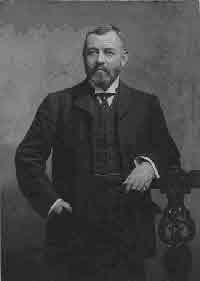
Alexander McCaul

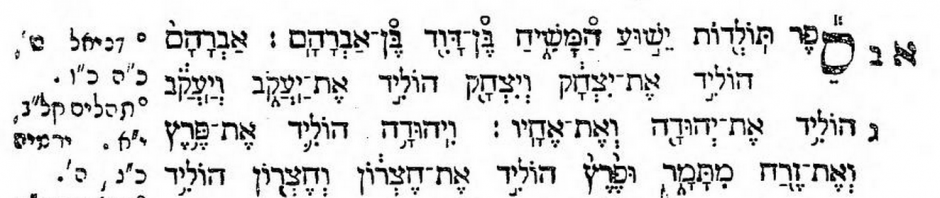
sefer Halikhot Orakh [Hebrew translation of Pilgrim’s Progress]
Published by Alexander Macintosh, Great New Street, London, England, 1844
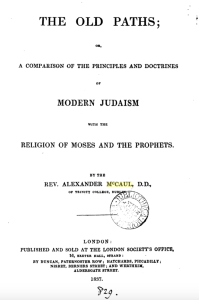
He became a Roman Catholic, adopting the name Stanislaus. However, he later embraced Evangelical Protestant Christianity, influenced by Alexander McCaul of the London Society for the Promotion of Christianity Amongst the Jews (LSPCJ) in Warsaw. He collaborated with McCaul. on the much published Hebrew treatise, Netivot Olam (The Old Paths), which critiqued rabbinic Judaism and became a centerpiece of 19th-century Jewish-Christian discussion. Hoga, fluent in Hebrew and well-versed in rabbinic literature, worked closely with McCaul, contributing to the translation of Christian texts, including Bunyan’s Pilgrim’s Progress and the New Testament into Hebrew. This groundbreaking work provided Jewish audiences with accessible Christian writings and showcased Hoga’s commitment to reconciling his Jewish heritage with his Messianic faith.
In addition to his religious and linguistic endeavors, Hoga demonstrated a keen interest in scientific inquiry. Reflecting the broader intellectual currents of his time, he sought to integrate scientific knowledge with theological reflection, illustrating the harmony between the natural world and the divine. His scientific work and writings, though less well-known than his translations and evangelistic efforts, reveal a polymathic intellect deeply engaged with the discoveries and debates of the 19th century. Hoga’s exploration of science was rooted in his conviction that the created world bore witness to its Creator and that scientific understanding could illuminate the truths of Scripture.
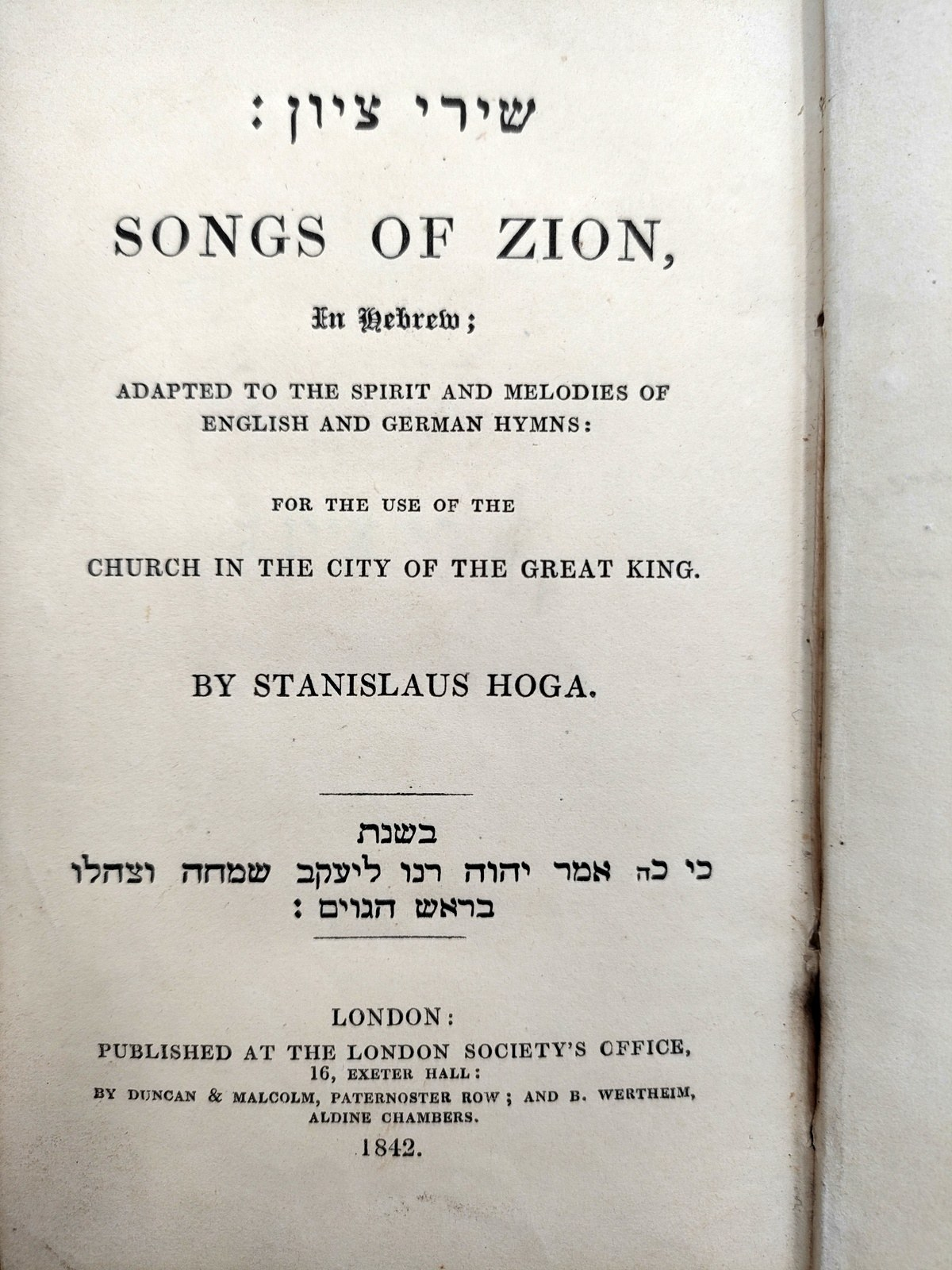
Hoga became a pioneering advocate for Messianic Judaism in Britain in the 1840s. His views were radical, asserting that Jewish believers in Yeshua remained within Judaism, bound by the Law, and should lead the Christian community. He published “The Controversy of Zion” in 1844, critiquing both Jewish and Christian errors. His vision for Messianic Judaism conflicted with the LSPCJ’s stance on the abrogation of Mosaic Law. His dissent led to his departure from the society. By 1849, Hoga had begun publishing critical articles about the LSPCJ in “The Jewish Chronicle” and other platforms
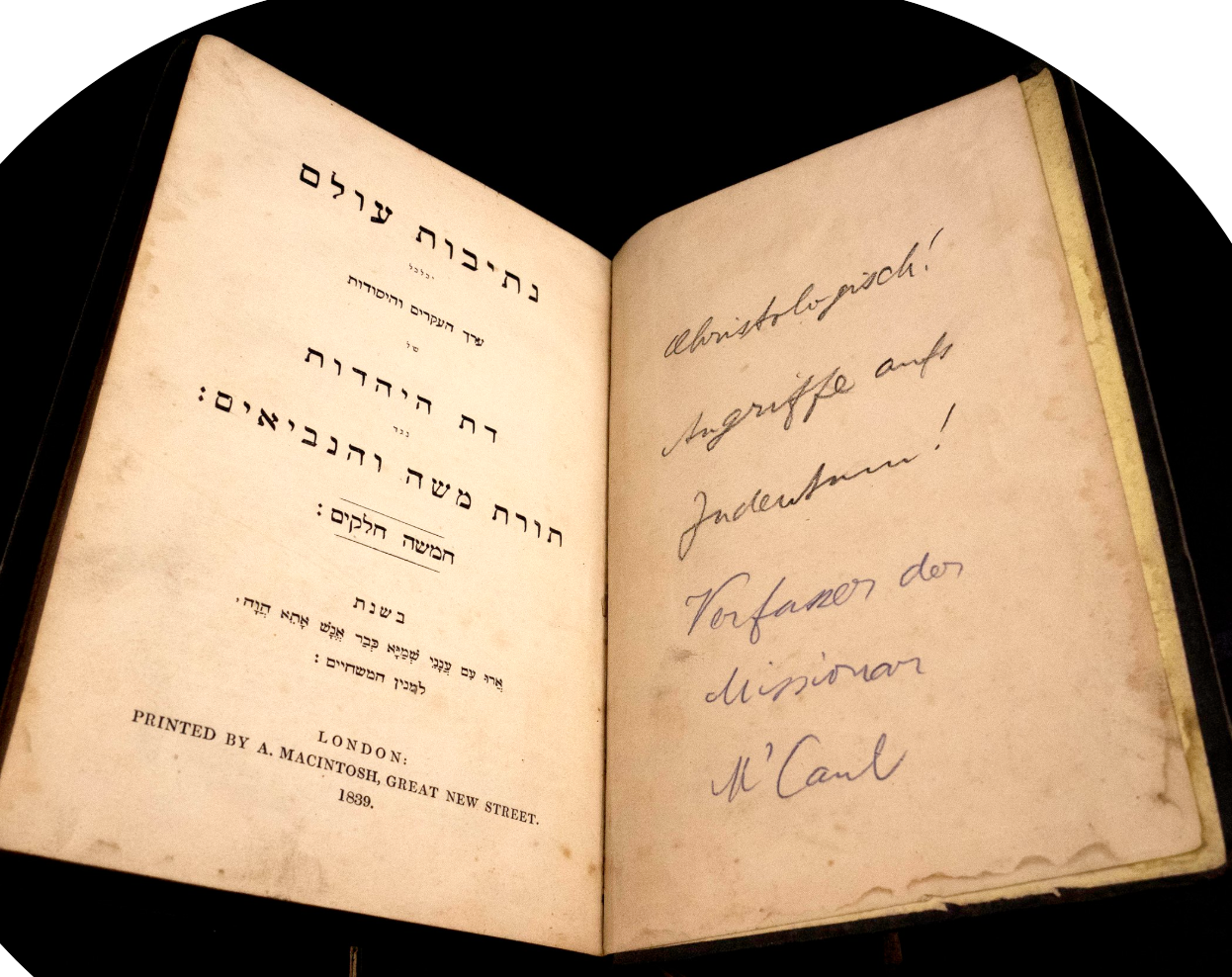
Despite his significant contributions, Hoga faced immense personal and social challenges. His status as a Jewish disciple of Yeshua left him marginalized within both communities. Yet, his work left an enduring legacy. His translations, writings, and scientific reflections paved the way for subsequent generations of Jewish believers in Yeshua, illustrating the compatibility of faith, intellectual inquiry, and cultural identity.

Grave of Hoga, Highgate cemetary, London
Hoga’s collaboration with McCaul also exemplified the complexities of 19th-century Jewish-Christian relations. While McCaul often took a polemical approach, Hoga’s contributions emphasized intellectual dialogue and the interpretation of Scripture through a Messianic lens. Together, they represented two complementary aspects of the LSPCJ—doctrinal engagement and pastoral welcome.
Reflection and Prayer:
Stanislaus Hoga’s life challenges us to consider how faith, intellect, and identity can coexist in ways that foster dialogue and understanding. His dedication to Scripture, science, and scholarship exemplifies a holistic approach to life and faith. Today, as we reflect on his contributions, may we be inspired to bridge divides, embrace intellectual curiosity, and celebrate the unity of faith and reason. Let us pray for those who Jewish disciples of Yeshua who, like Hoga, seek to live authentically at the intersection of tradition and transformation, embodying reconciliation and hope in their lives.
Publications and Further Reading:
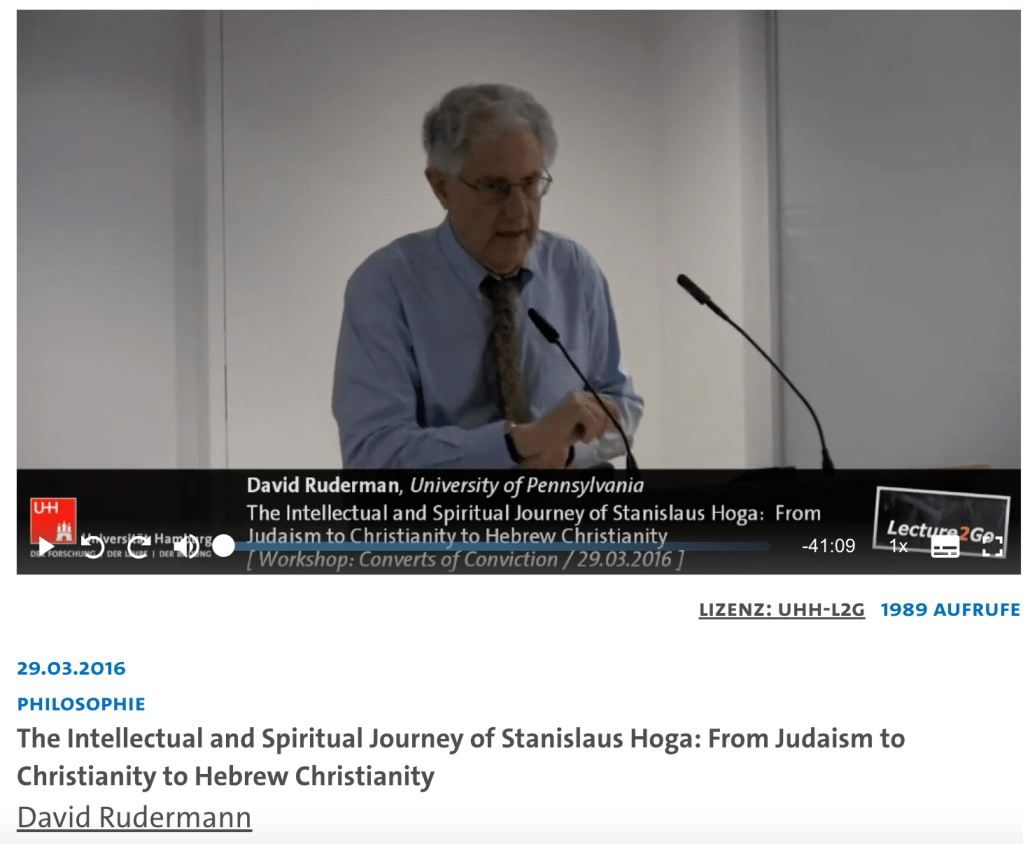
https://lecture2go.uni-hamburg.de/l2go/-/get/v/19120
• Alexander McCaul, Netivot Olam (The Old Paths)
• David B. Ruderman, Missionaries, Converts, and Rabbis: The Evangelical Alexander McCaul and Jewish-Christian Debate in the Nineteenth Century
• Writings and translations by Stanislaus Hoga, preserved in 19th-century mission and scientific archives
https://en.wikipedia.org/wiki/Stanislaus_Hoga
Stanislaus Hoga—Apostate and Penitent by Beth-Zion Lask Abrahams, Transactions (Jewish Historical Society of England), 1939-1945, Vol. 15 (1939-1945), pp. 121-14
Stable URL: https://www.jstor.org/stable/29777844
Such is the story of the pilgrimage of the man known variously
throughout the stages of his life’s journey as Yecheskel Aryeh, as
Chaskel Meshumad, and as Stanislaus Hoga. His was a journey
of escape from life: out of Chassidism to the allure of enlighten?
ment, thence to refuge in apostasy, only to seek peace of so
https://www.dropbox.com/s/fzulp312spf0urf/stanislaus%20hoga.pdf?dl=0
https://www.dropbox.com/s/4dxklhc2tlou547/ruderman%20stanislaus%20hoga.pdf?dl=0
A very extraordinary advertisement appears in No. 79 of the Jewish Chronicle, issued by Stanislaus Hoga, proposing a “new Jewish monthly publication, in Hebrew and English, to be called ציד נאמן ‘The Faithful Missionary.’” The programme set forth, which occupies two columns and a half, promises an expose of operations of the “London Society for promoting Christianity among the Jews.” It appears that this Mr. Hoga, who is admitted to be the greatest Hebrew scholar in England, was formerly in the employ of this society; but, either from conviction of his errors, or through some misunderstanding with his employers, he seems to have declared war against them, and promises to expose their machinations, which he threatens in such language as the following, which is No. 4 of the twenty-three things he proposes to do. “4. He will give full information of the commencement, progress. and conduct of the society; how this adulterous child was born, by whom it was cradled and fostered, until (as the present traders it) apostacy tell their dupes) ‘Kings are become its nourishing fathers, and queens its nourishing mothers.’” Besides this he proposes to refute attacks against Judaism by professors of Christianity, and to explain the history and character of both. There is no doubt that this extraordinary publication, if it ever do come to anything, will create considerable agitation and alarm among the officers and dependents of the “London Society,” whose situations will be jeopardized by some of the revelations promised to its patrons and supporters. The Jews will look on with some interest, and regard the affair as a “pretty quarrel as it stands.” I see that the “Voice of Jacob,” does not admit the advertisement, but takes notice of the matter as a piece of news only. https://onthemainline.blogspot.com/search?q=hoga


 On This Day In Messianic Jewish History